


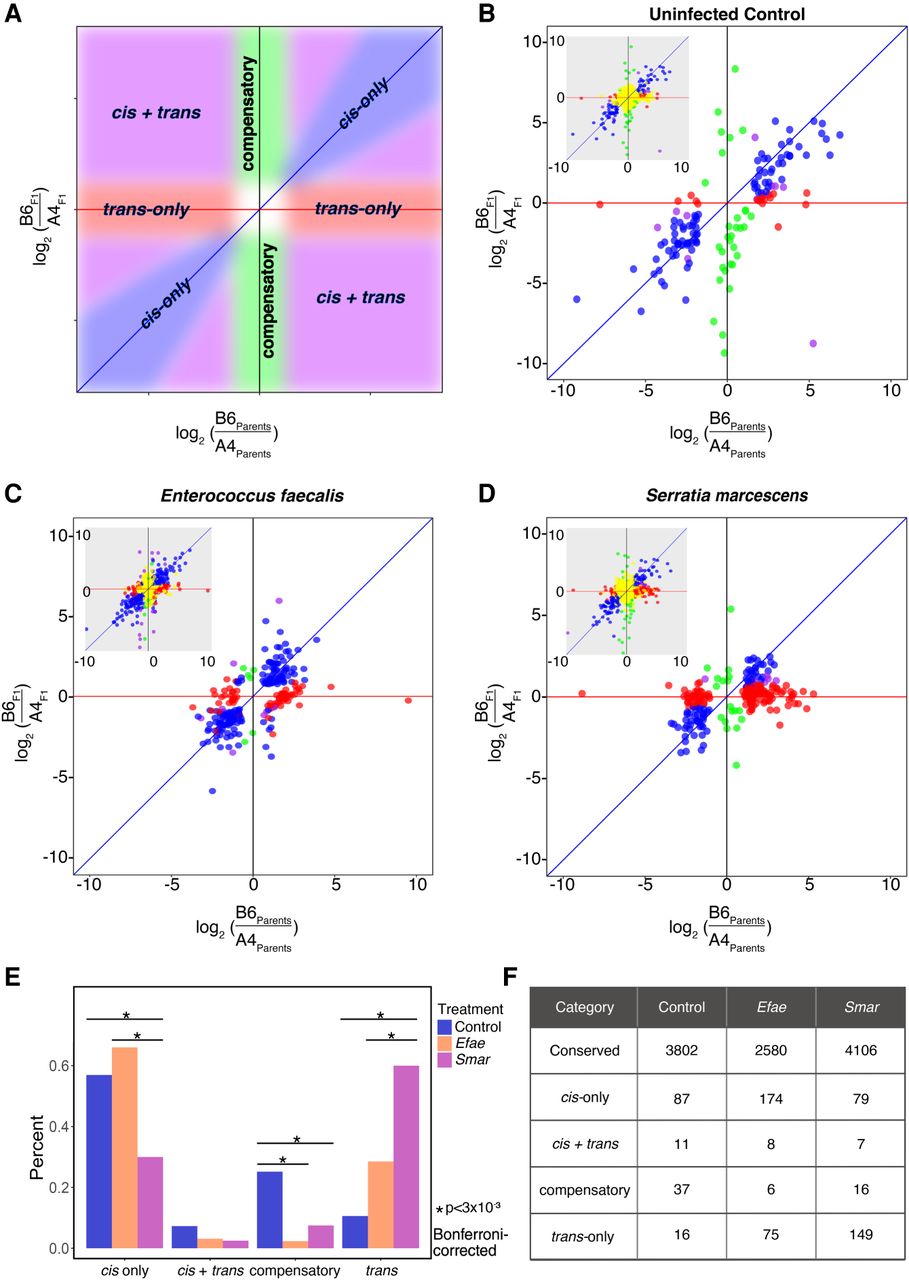
The relative contributions of cis and trans effects to expression divergence are condition specific. (A) Here we show a schematic of the expected locations for genes falling into four classifications of causes of expression divergence in plots that show the expression ratio of a gene in the parental lines (x-axis) against the allele expression ratio in the F1 hybrids (y-axis). (B) In the uninfected control condition, of 4960 genes that could be detected in an allele-specific manner, 153 genes showed cis or trans signal. Of these 153 genes, most showed cis-acting effects. Panel F displays the precise numbers of genes in each category. (C) In response to Efae infection, expression divergence is driven predominantly by changes in cis. (D) In response to Smar infection, expression divergence is dominated by changes in trans. (E) We compared the fraction of genes categorized into each divergence class in the three conditions and found that the modes of expression divergence were condition specific.



