


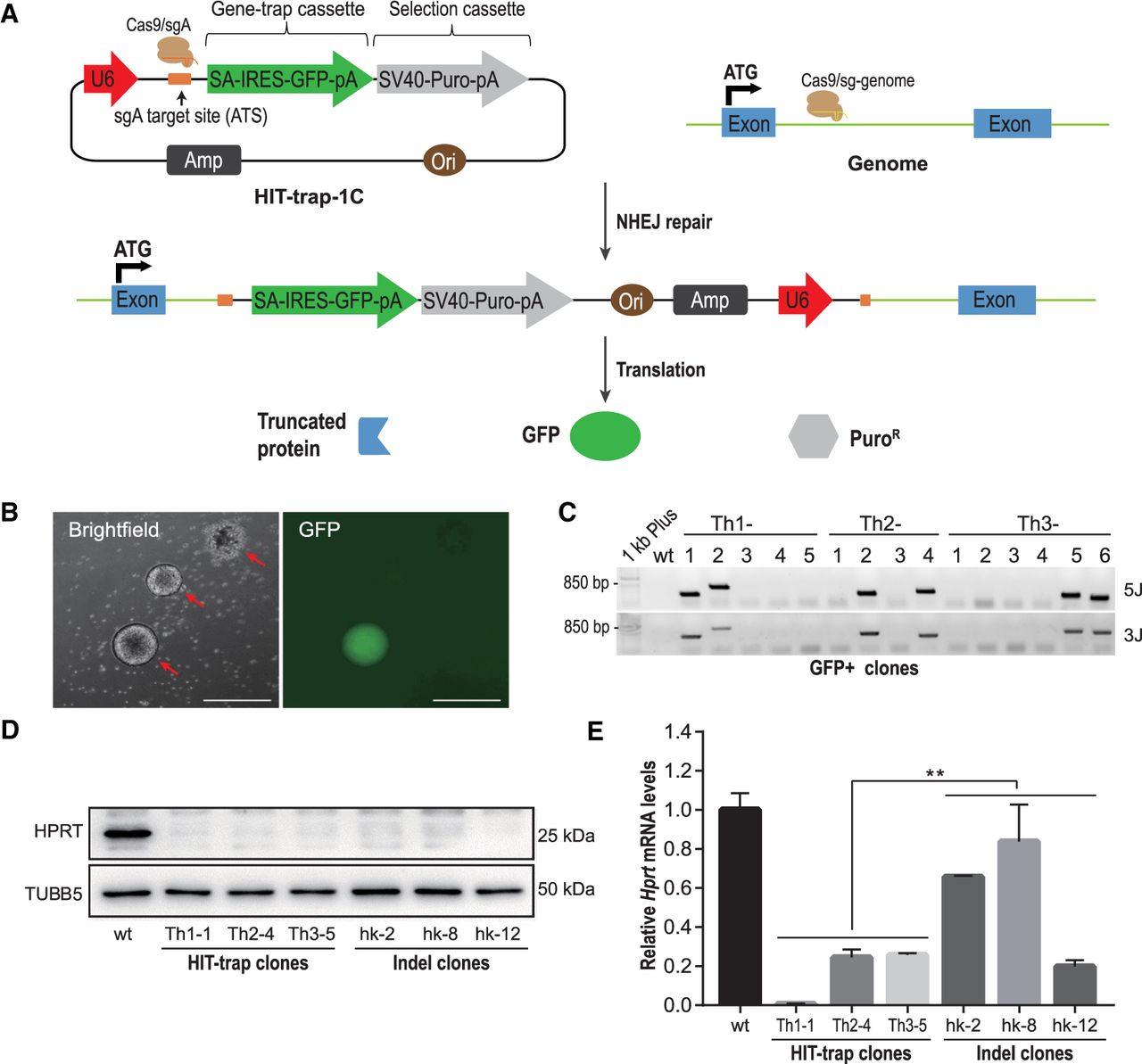
Insertional mutagenesis induced by HIT-trapping in mESCs. (A) Schematic of the HIT-trapping strategy. Concurrent cleavage of the HIT-trap donor and genome by Cas9 RNPs results in targeted trapping. After integration, the gene-trap cassette leads to the expression of a truncated protein and GFP by the promoter of the target gene. The selection cassette expresses a puromycin-resistance gene by a constitutive SV40 promoter. (ATS sequence) GGTATGTCGGGAACCTCTCCAGG; (SA) splice acceptor; (IRES) internal ribosome entry site; (pA) polyadenylation signal. (B) Representative microscopic images of mESC clones after puromycin selection in HIT-trapping. Red arrows indicate apoptotic clone (top), GFP-negative surviving clone (middle), and GFP-positive surviving clone (bottom), respectively. Scale bar, 50 µm. (C) PCR genotyping of GFP-positive clones confirmed the correct integration of HIT-trap donor at Hprt locus. 5/3J, 5′/3′ junction. (D,E) Western blot and qPCR analysis of HIT-trap clones targeting the Hprt locus (Th1-1, Th2-4, and Th3-5), with TUBB5 as the loading control. Error bars, SD from three technical replicates. Significance was calculated using the Student's unpaired t-test: (**) P < 0.01.


