


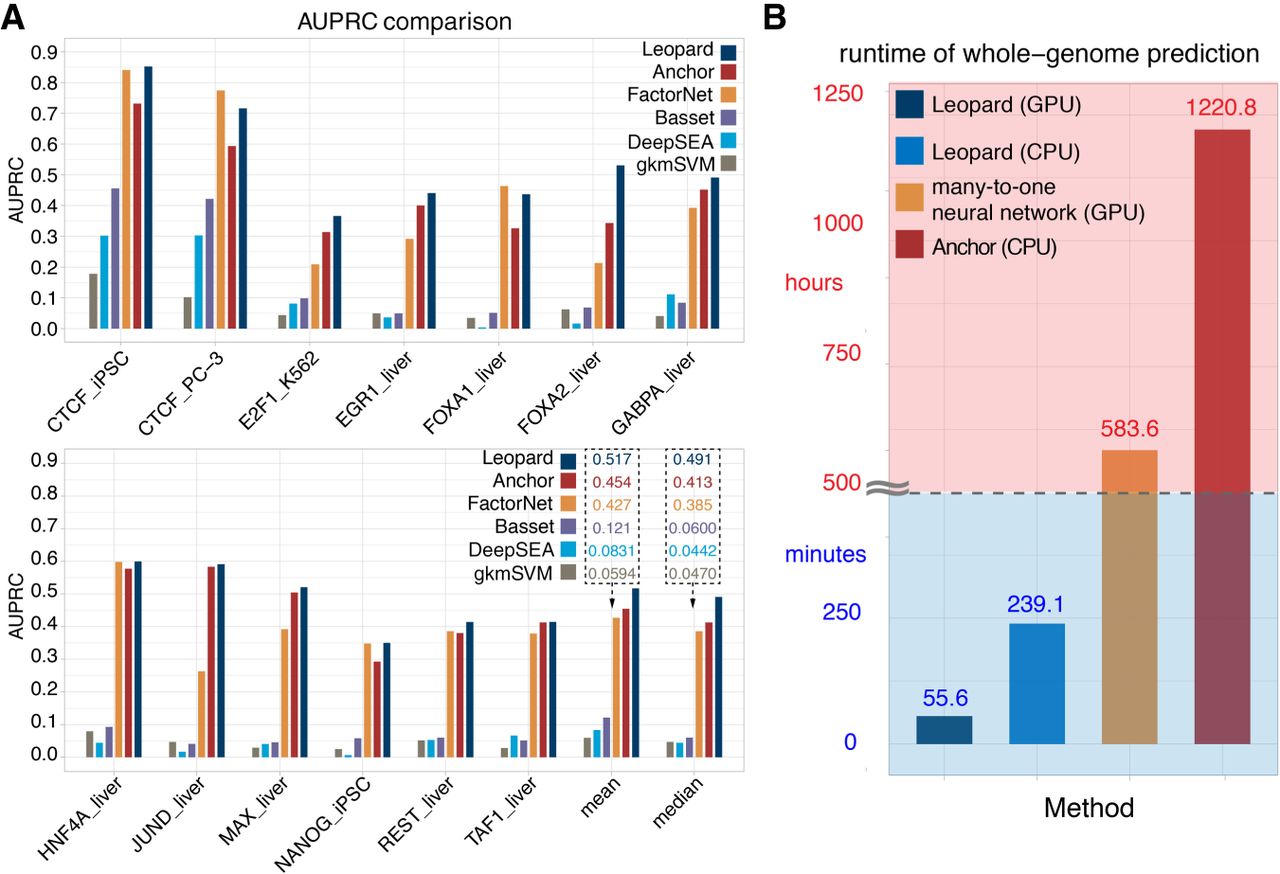
Leopard substantially improves TF binding site prediction over state-of-the-art methods. (A) Leopard was benchmarked with the top performing classical tree-based model (Anchor), the top performing neural network model (FactorNet) in the ENCODE-DREAM in vivo TF binding site prediction challenge, two recent deep learning approaches (DeepSEA and Basset), and a classical machine learning method (gkmSVM). The same challenge training and testing data sets were used to train models and evaluate performance. Overall, Leopard achieved higher prediction AUPRCs than did the other methods. The mean and median AUPRCs on the bottom right clearly show the advantage of Leopard predictions in the 13 testing TF–cell type pairs. Leopard substantially improved the median prediction AUPRC by 19% and 27% over Anchor and FactorNet, respectively. (B) The runtime was tested for predicting the HNF4A binding profiles in the liver cell using different methods. Leopard shows a great advantage of speed and is flexible with both GPU and CPU.



