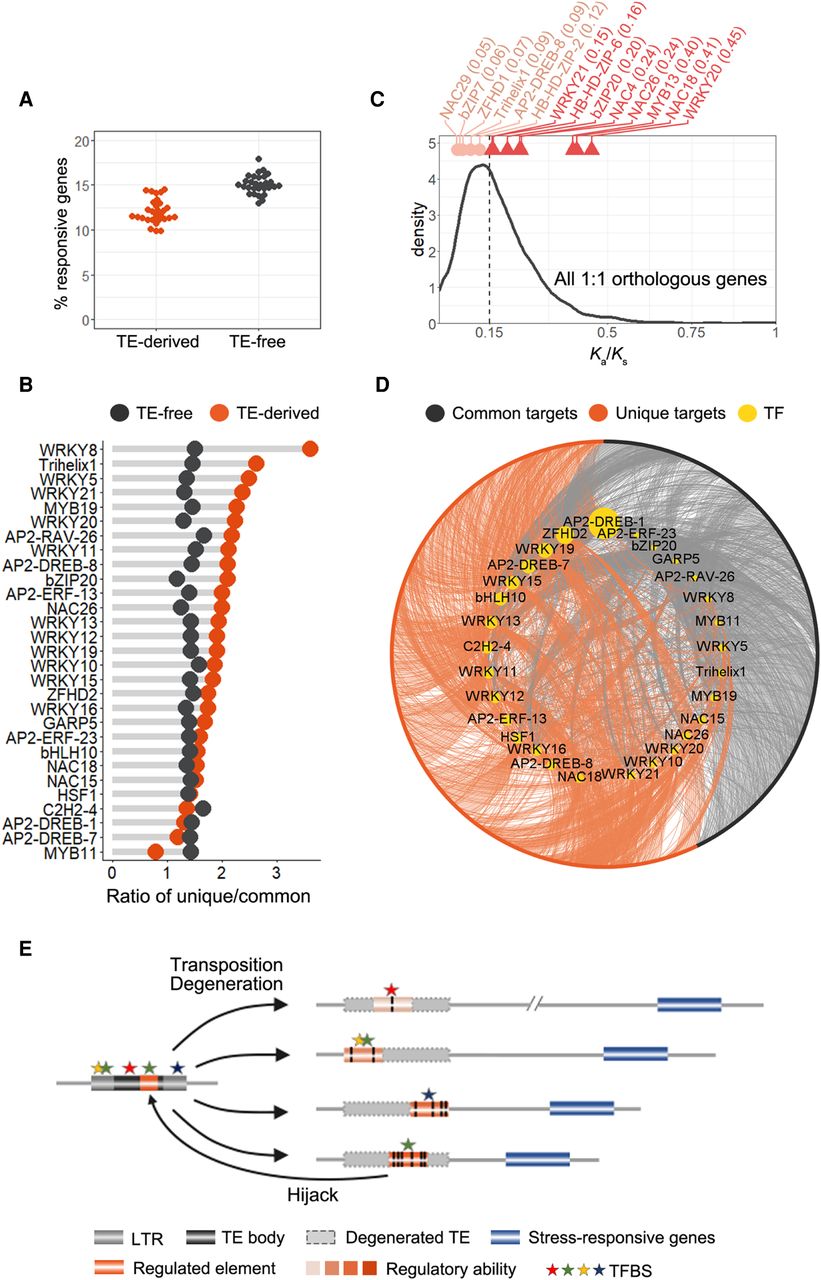
TE-derived TFBSs have wired new genes into the regulatory network of wheat environmental responses. (A) Fraction of TE-derived TFBSs and TE-free TF targets induced by abiotic stresses. (B) Ratio of unique response genes in wheat and commonly induced genes in Tu and Os. Orange spots represent TE-derived TFBSs. Black spots represent TE-free TFBSs. The TFs with the number of targets induced by abiotic stresses greater than 20 were kept. (C) Ka/Ks ratio of TFs between Os and Tu. The values for 1:1 orthologous TFs are shown on top, and the line plot represents the background of Ka/Ks distribution for all 1:1 orthologous genes between Os and Tu. TFs with Ka/Ks ratios greater than the median of all 1:1 orthologous genes are in dark orange; other TFs displayed in light orange. (D) Network showing incorporation of new stress-responsive genes by TE-derived TFBSs. TEs in A are shown. (E) Model illustrating the rewiring of the gene regulatory network by TE-derived TFBSs. Left: Some TFBSs or TFBS precursors exist within specific TEs, transposition of which leads to expansion of corresponding TFBSs or precursors. Right: Transposed TEs were degenerated and lost typical TE structures, but some TFBSs present in TEs were evolutionarily selected for regulating nearby gene activity. The closer the TE-derived TFBS to genes, the stronger the regulatory activity. The reverse arrow at the bottom illustrates that some TE-embedded TFBSs may be hijacked from the non-TE TFBSs.