


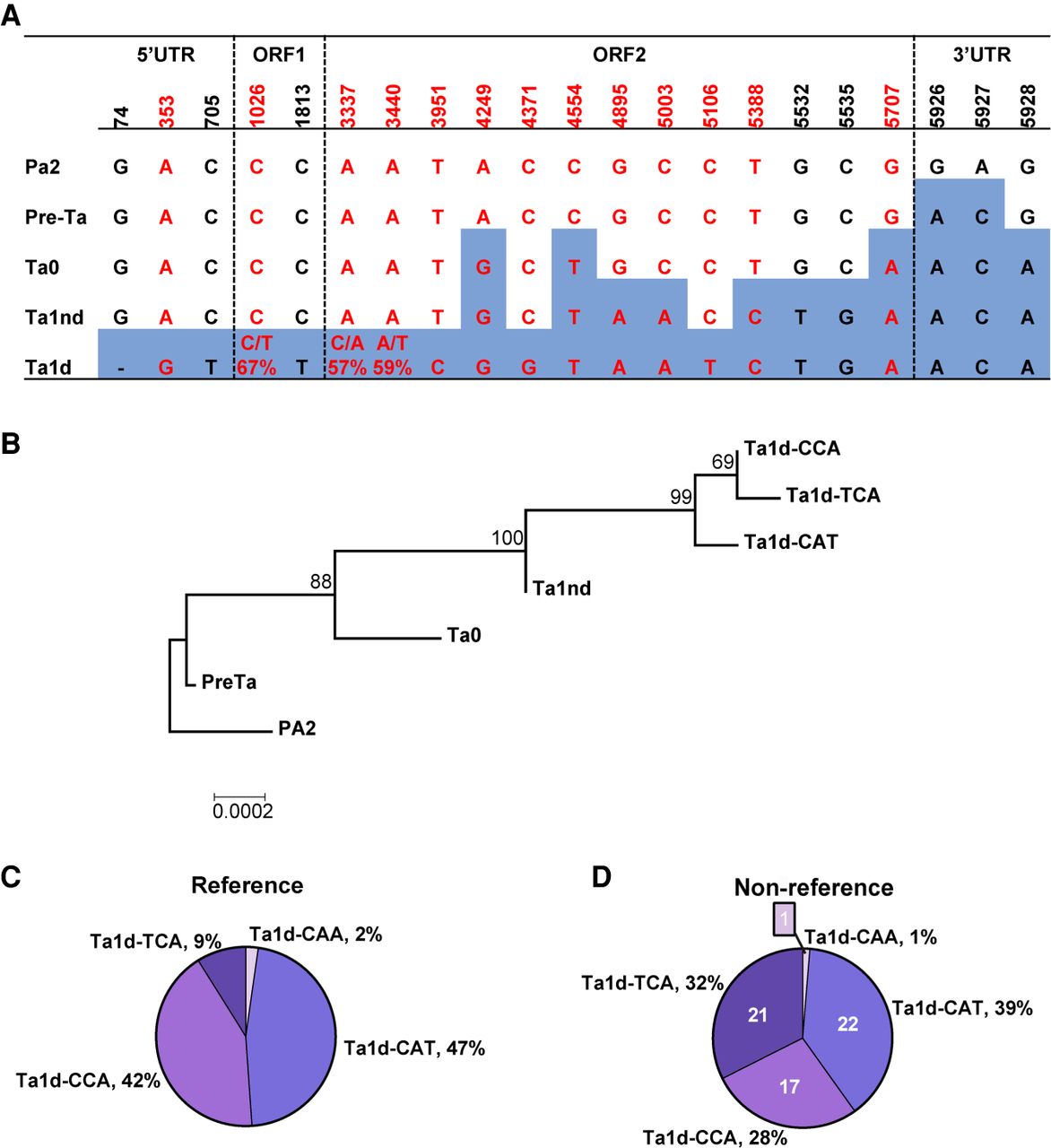
Three novel Ta1d subfamilies of FL-L1Hs elements. (A) Table of canonical positions defining L1 subfamilies building upon those published previously (Boissinot et al. 2000; Brouha et al. 2003). Positions in red are new canonical positions discovered in our sequenced FL-L1Hs elements. Note that positions 1026, 3337, and 3440 define three new subfamilies according to the sequences at those positions. (B) A phylogenetic tree was constructed using subfamily consensus sequences to evaluate the relationship of known subfamilies versus new ones (Supplemental Table S3C). The tree was calculated using the neighbor-joining method and distances were corrected using the Kimura 2-parameter model. The numbers at each node represent the percentage of replicate trees that clustered together in 1000 bootstrap tests. (C,D) Reference and non-reference proportions of Ta1d subfamilies that show expansion of the Ta1d-TCA subfamily in non-reference populations (D). Note the expansion from 9% to 32% (dark purple) when comparing the Ta1d-TCA subfamily in reference (C) versus non-reference (D). The white numerals in D indicate the number of FL-L1Hs elements that were found to be active in the literature for each subfamily (Supplemental Table S3A).



