


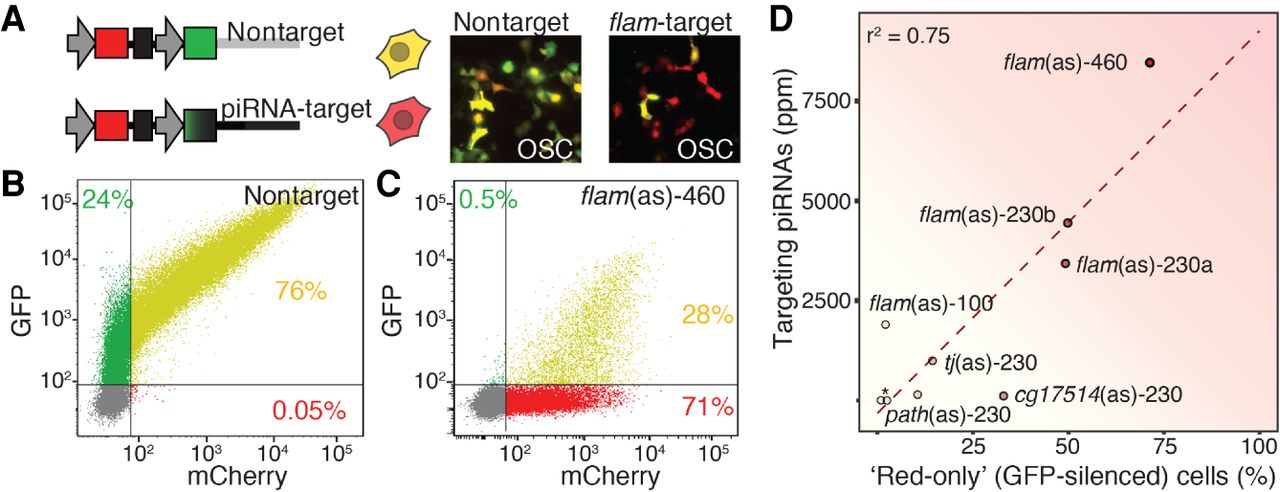
Silencing directly correlates with piRNA abundance. (A) A reporter assay for Piwi-piRNA silencing. GFP (green) reports silencing by endogenous piRNAs. mCherry (red) serves as a control. GFP and mCherry are expressed from the same plasmid by individual promoters and separated by an insulator sequence. Different target sites with antisense complementarity to piRNA-generating regions were inserted into the 3′ UTR of GFP (piRNA target) (Supplemental Table S4). Sensors were expressed in ovarian somatic sheath cells. Expression of the dual color reporter was visualized (A) and measured by flow cytometry (B,C) 48 h after transfection. (B) Without any target site (nontarget), the sensor expressed both fluorophores in 76% of the transfected cells. (C) A flamenco (lncRNA:flam)-target sensor (flam[as]-460) showed complete silencing of GFP in 71% of the transfected cells (“red only” cells). (D) piRNA abundance correlates with silencing. Correlation of “red-only” (GFP-silenced) cells and the total abundance of complementary piRNAs (in parts per million). Pearson correlation coefficient (r2). piRNA-sensors with different target sequences complementary to flamenco (lncRNA:flam) (varying target length: 100, 230, 460 nt) or complementarity to other piRNA-producing regions: traffic jam (tj), pathetic (path), l(3)80Fj (CG17514), and two different intervals of Cyclin B (*) (constant length 230 nt) (Supplemental Table S4). The dispersion of data points might be partly caused by quantifying fully complementary piRNAs as a surrogate for targeting piRNAs (y-axis), and by only considering completely silenced (“red-only”) cells (x-axis). Future improvements in our understanding of piRNA:target engagement will enable refinement of these scores.



