


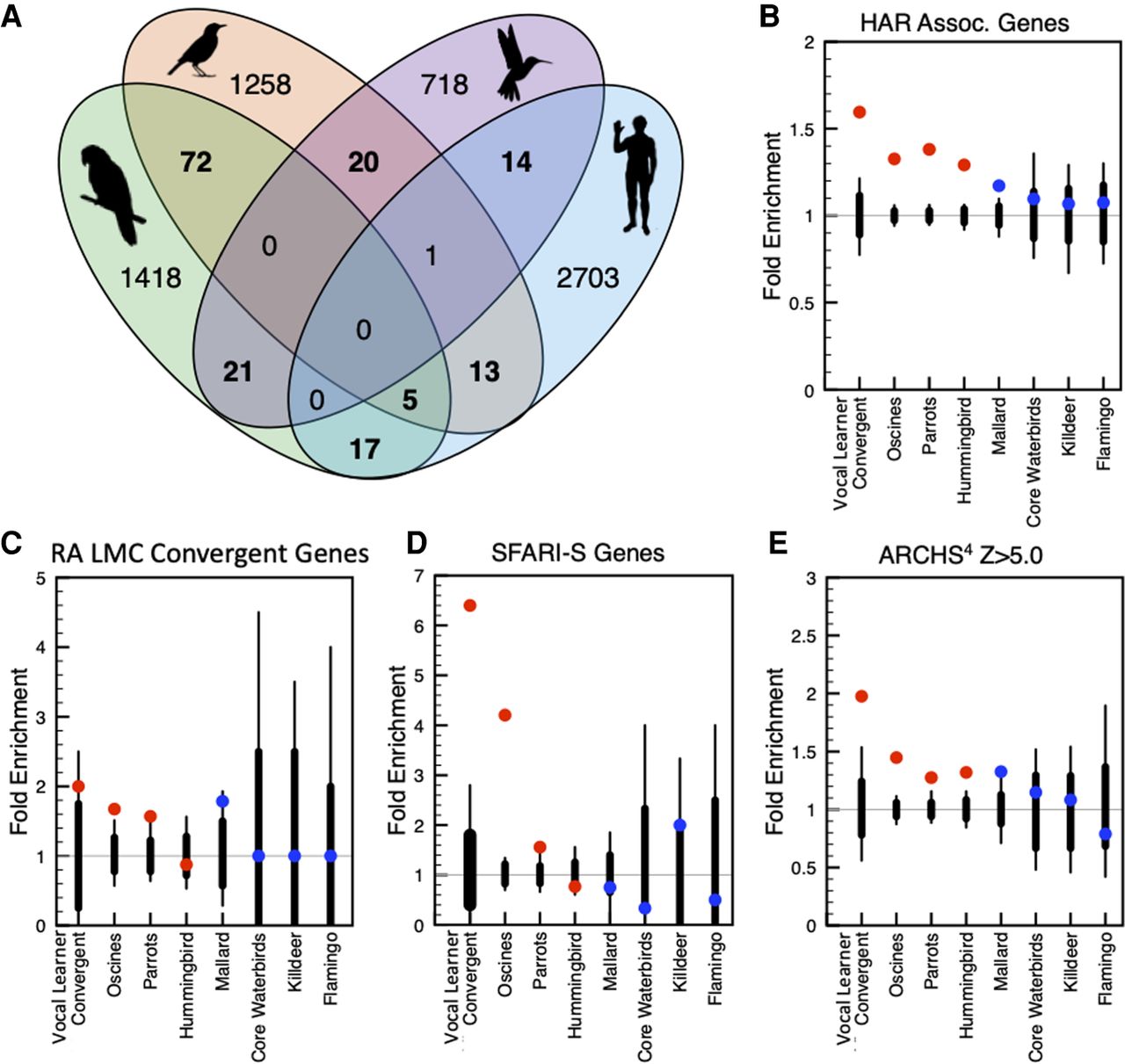
Tests for human convergence and vocalization enrichment. (A) Venn diagram of convergence between avian and human ARs that are mappable between birds and humans. (B–E) Tests for enrichment of ARs associated with gene lists of strong relevance to human-avian convergence and vocal learning. Vocal learning bird (red) and waterbird (blue) dots indicate the observed association between ARs and genes in the list; black bars give the distribution of values expected by chance under 95% (thick) and 99.9% (thin) of cases; expected value ranges are inversely proportional to the number of ARs and to the size of the gene list. Gene lists include: (B) genes associated with one or more human accelerated regions; (C) genes identified as convergently differentially expressed between vocal learning birds’ RA song nucleus and the human laryngeal motor cortex by Pfenning et al. (2014); (D) SFARI class S genes associated with syndromic forms of autism spectrum disorders; and (E) genes identified as coexpressed with vocalization behavior GO-term genes to Z > 5.0.



