


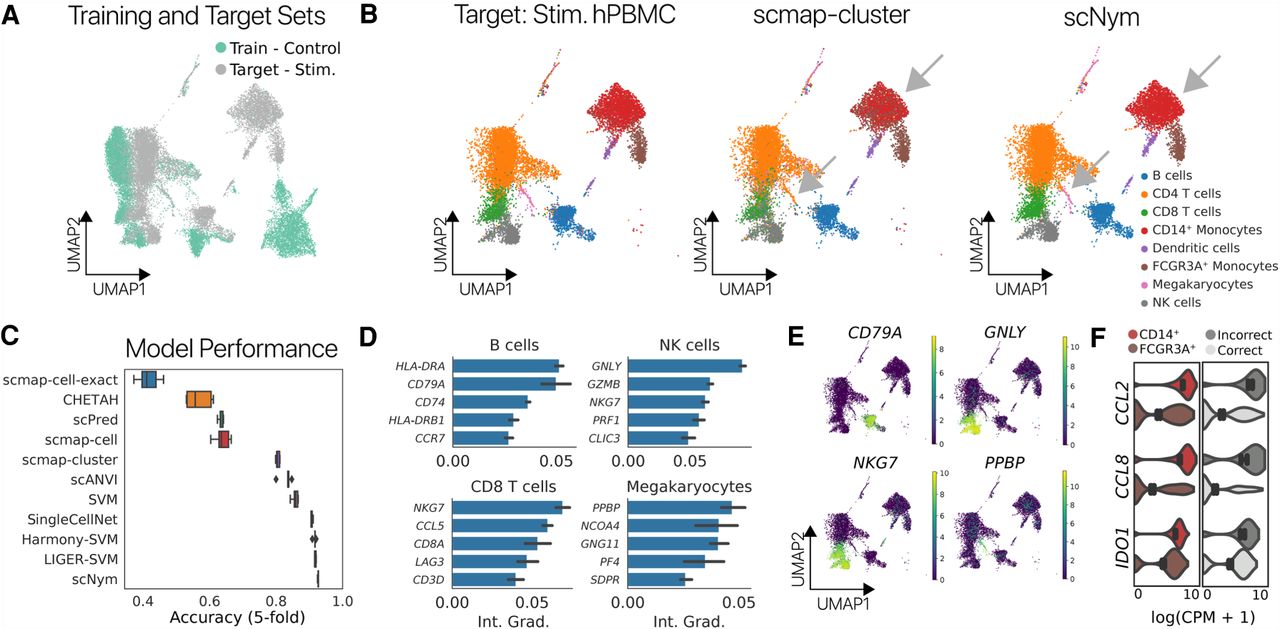
scNym transfers annotations from unstimulated immune cells to stimulated immune cells. (A) UMAP projection of unstimulated PBMC training data and stimulated PBMC target data with stimulation condition labels. (B) UMAP projections of ground truth cell type labels (left), scmap-cluster predictions (center), and scNym predictions for both CD14+ and FCGR3A+ monocytes. scmap-cluster confuses these populations (arrow). (C) Classification accuracy for scNym and baseline cell identity classification methods. scNym is significantly more accurate than other approaches (P < 0.01, Wilcoxon rank sums). (D) Integrated gradient analysis reveals genes that drive correct classification decisions. We recover known marker genes of many cell types (e.g., CD79A for B cells, PPBP for megakaryocytes). (E) Cell type specificity of the top salient genes in a UMAP projection of gene expression (log normalized counts per million). (F) Integrated gradient analysis reveals genes that drive incorrect classification of some FCGR3A+ monocytes as CD14+ monocytes. Several of the top 15 salient genes for misclassification are CD14+ markers that are up-regulated in incorrectly classified FCGR3A+ cells.



