


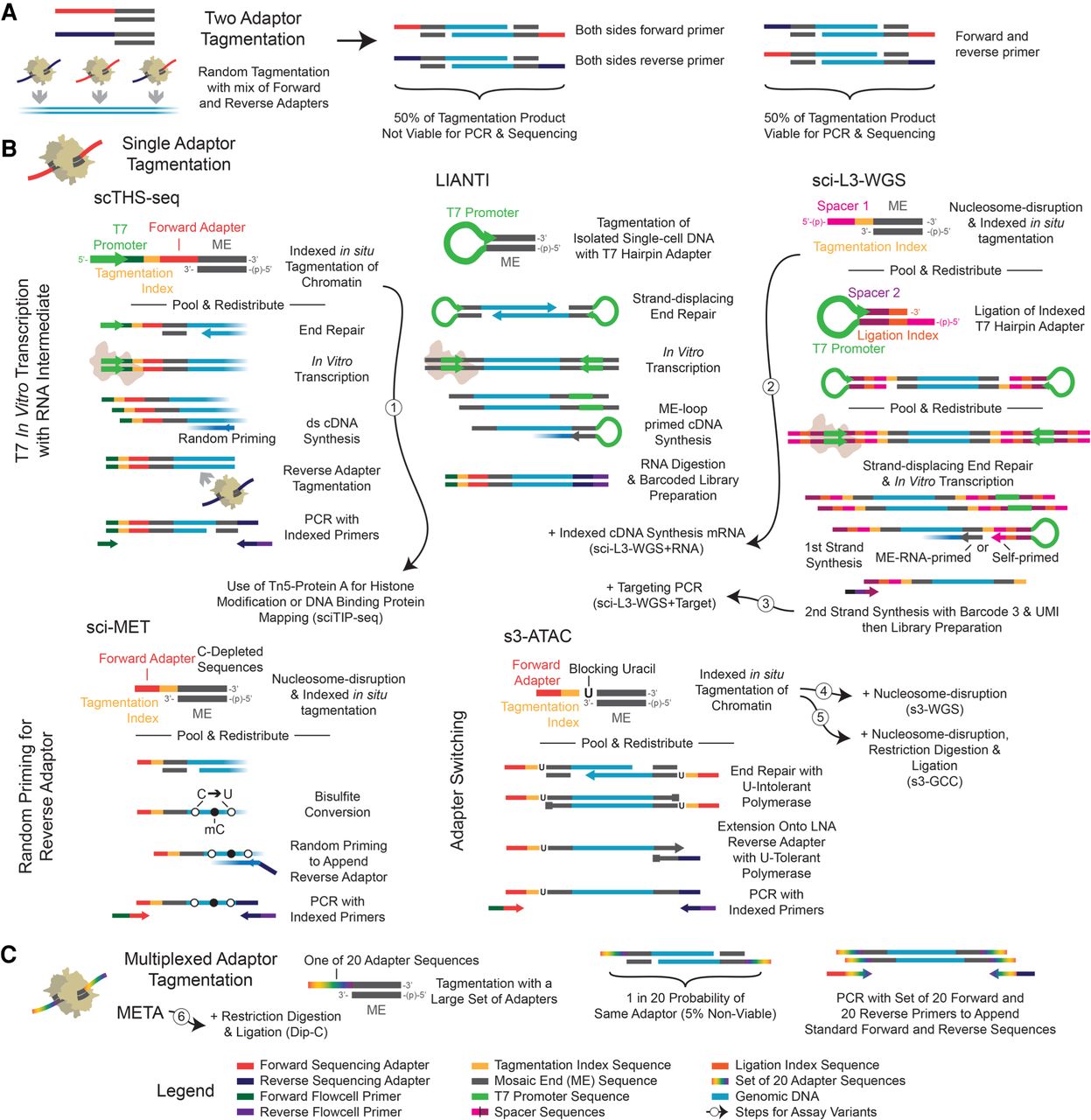
Transposome strategies to improve efficiency. (A) The standard tagmentation reaction randomly incorporates a mix of forward and reverse adapters. This results in 50% of the resulting molecules with both a forward and reverse adapter that can be carried through subsequent processing steps, with such fragments preferentially forming hairpin complexes rather than primer annealing during PCR and also being unable to form sequencing clusters. The remaining 50% are flanked by two forward or by two reverse adapter sequences and are not viable. This effectively caps the maximum efficiency of two-adapter tagmentation at 50%. (B) Several strategies have been developed that use single-adapter tagmentation with an alternative means of appending a reverse adapter. Three of these use tagmentation with a T7 promoter to enable linear amplification using in vitro transcription. The other two use either random priming or adapter switching strategies. Arrows indicate alternative processing workflows: (1) sciTIP-seq to obtain histone modification profiles, (2) sci-L3-WGS + RNA to capture RNA alongside DNA, (3) capture of targeted regions of the genome within the sci-L3-WGS workflow, (4) s3-WGS to capture whole-genome sequence with the s3 workflow, and (5) s3-GCC to capture both WGS and chromatin folding with the s3 workflow. (C) Tagmentation with an expanded set of adapters reduces the probability of producing fragments that terminate in the same adapter species from 50% to 1/n, where n is the number of adapter species present.



