


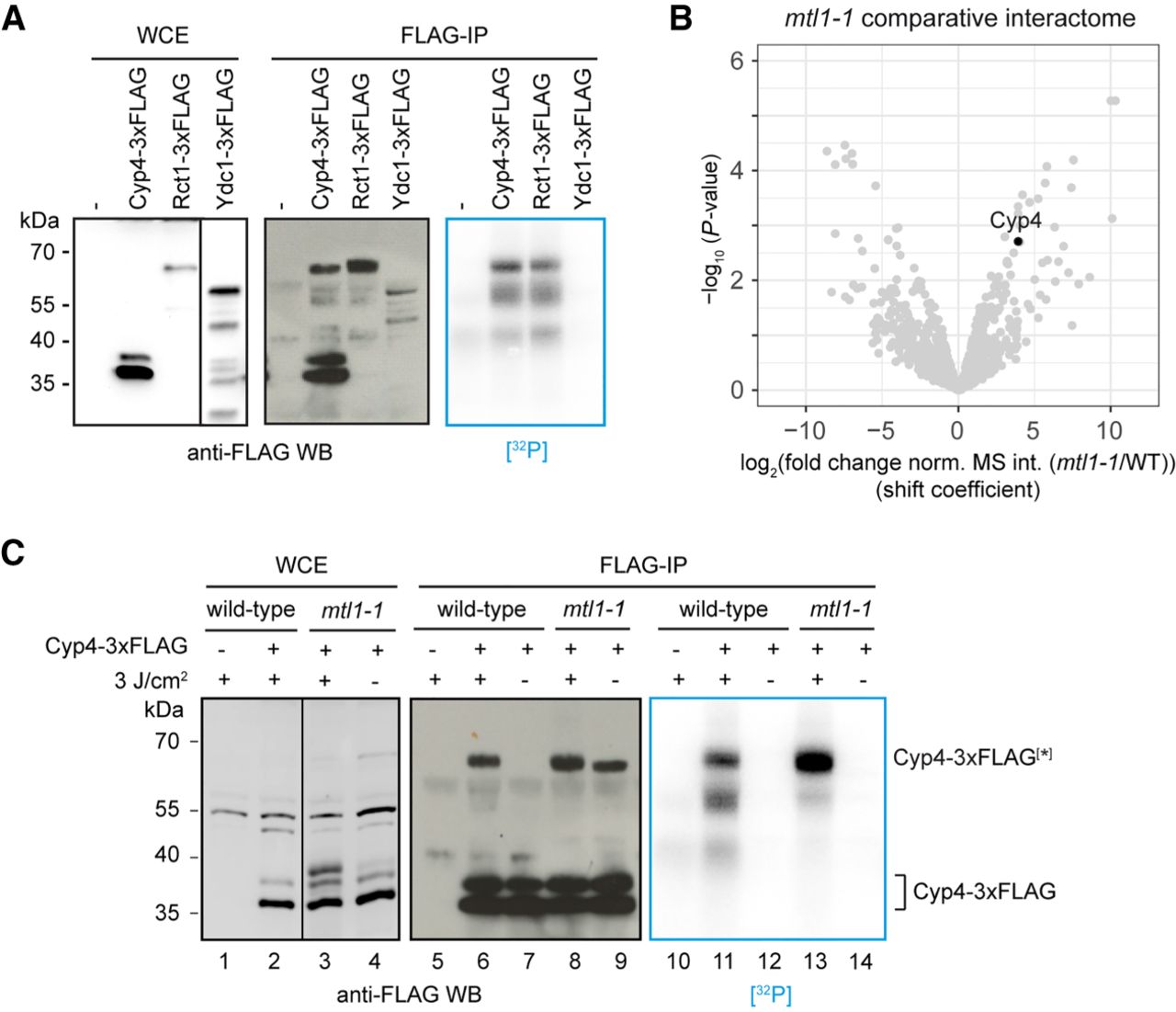
Only a subpopulation of the substoichiometric RBP Cyp4 interacts with RNA. (A) Crosslinking and immunoprecipitation (CLIP) analysis of FLAG-tagged proteins captured from WCEs of 4sU-labeled UV-crosslinked cells (3J/cm2). After RNase digest, 5′ ends of crosslinked RNAs were radioactively labeled using T4 polynucleotide kinase and [γ-32P]ATP, and complexes were separated by gel electrophoresis followed by membrane transfer. A nontagged strain was included as control. All shown WCE samples are from the same membrane at the same exposure; irrelevant lanes were removed. (B) Volcano plot of a comparative RIC experiment for mtl1-1 as in 4E. Poly(A)+ RNA association of Cyp4 is increased compared to WT. (C) CLIP analysis of FLAG-tagged Cyp4 in wild-type or mtl1-1 as in A. Non-irradiated cells and a nontagged strain were included as controls. (*) Cyp4 species that migrates at a higher apparent molecular weight. Although the band is apparently stabilized by crosslinking, it is present in noCL samples where no associated RNA can be detected (lanes 9 and 14). All shown WCE samples are from the same membrane at the same exposure; irrelevant lanes were removed.



