


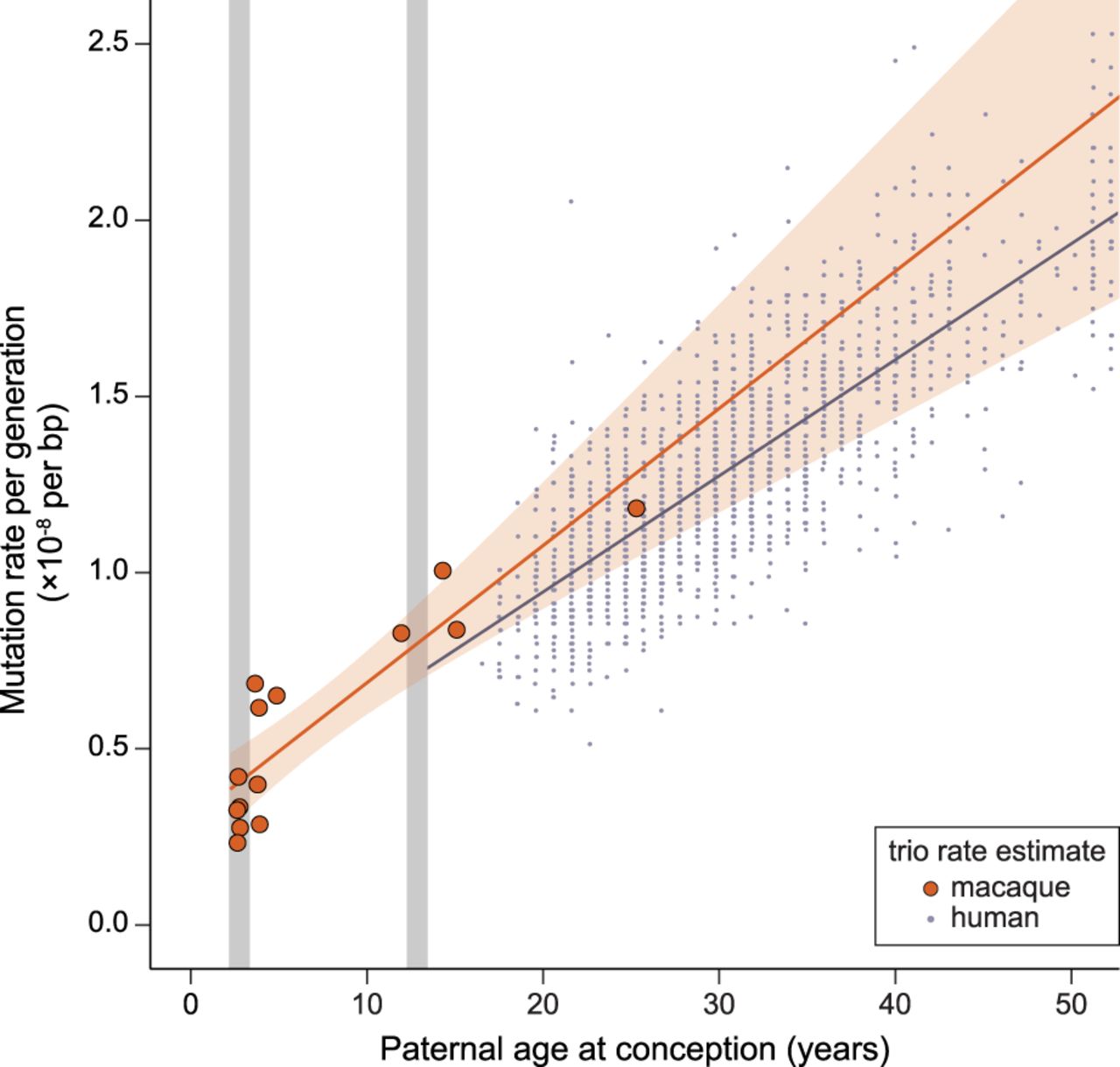
Similar rates of mutation accumulation postpuberty in human and rhesus macaque. Mutation rate accumulation with paternal age estimated from trios in macaques (orange) and humans (black) (data from Jónsson et al. 2017). Approximate ages at male puberty in the macaque (3.5 yr) and human (13.5 yr) are shown in gray. Human trios with paternal age up to 50 are shown here, but the human regression line is from the full data set. The rate at which the mutation rate increases with paternal age is slightly higher in the macaque (4.3 × 10⁻¹⁰ per bp per year; Poisson regression) than in human (3.4 × 10⁻¹⁰ per bp per year). The intercept with puberty is much lower in macaque (3.9 × 10⁻⁹ per bp) than in human (7.1 × 10⁻⁹ per bp).



