


Cover image
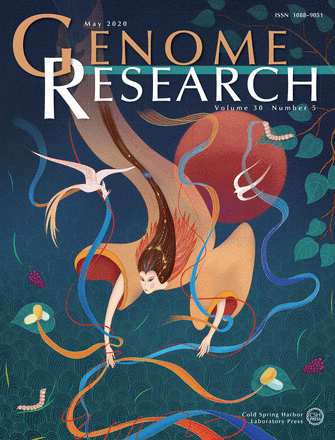
According to Chinese legend, Empress Leizu invented sericulture, or silk farming, an industry that connected the East and the West via the Silk Road. Currently, the rapid development of genome editing technologies (the CRISPR-Cas9 complex is represented by the moon and the silk belts swirling around) is empowering researchers to comprehensively investigate the function of silkworm genes (the genome is represented by the orange double helix–shaped silk bands in Leizu's hands). In this issue, the establishment and application of a genome-wide CRISPR knockout library (represented by scattered cocoons and mulberries) in a cultured silkworm cell line is reported. A large subset of genes and pathways are found to be crucial for normal growth, temperature stress, or virus invasion. In addition, several genes that can be potentially used to generate baculovirus-resistant varieties were experimentally validated. (Cover artwork by Sanyuan Ma and Huijie Zhang with contributions to the final image from Qiushi Wang (https://www.zcool.com.cn/u/176004/profile#tab_anchor). [For details, see Chang et al., pp. 757–767.])

