


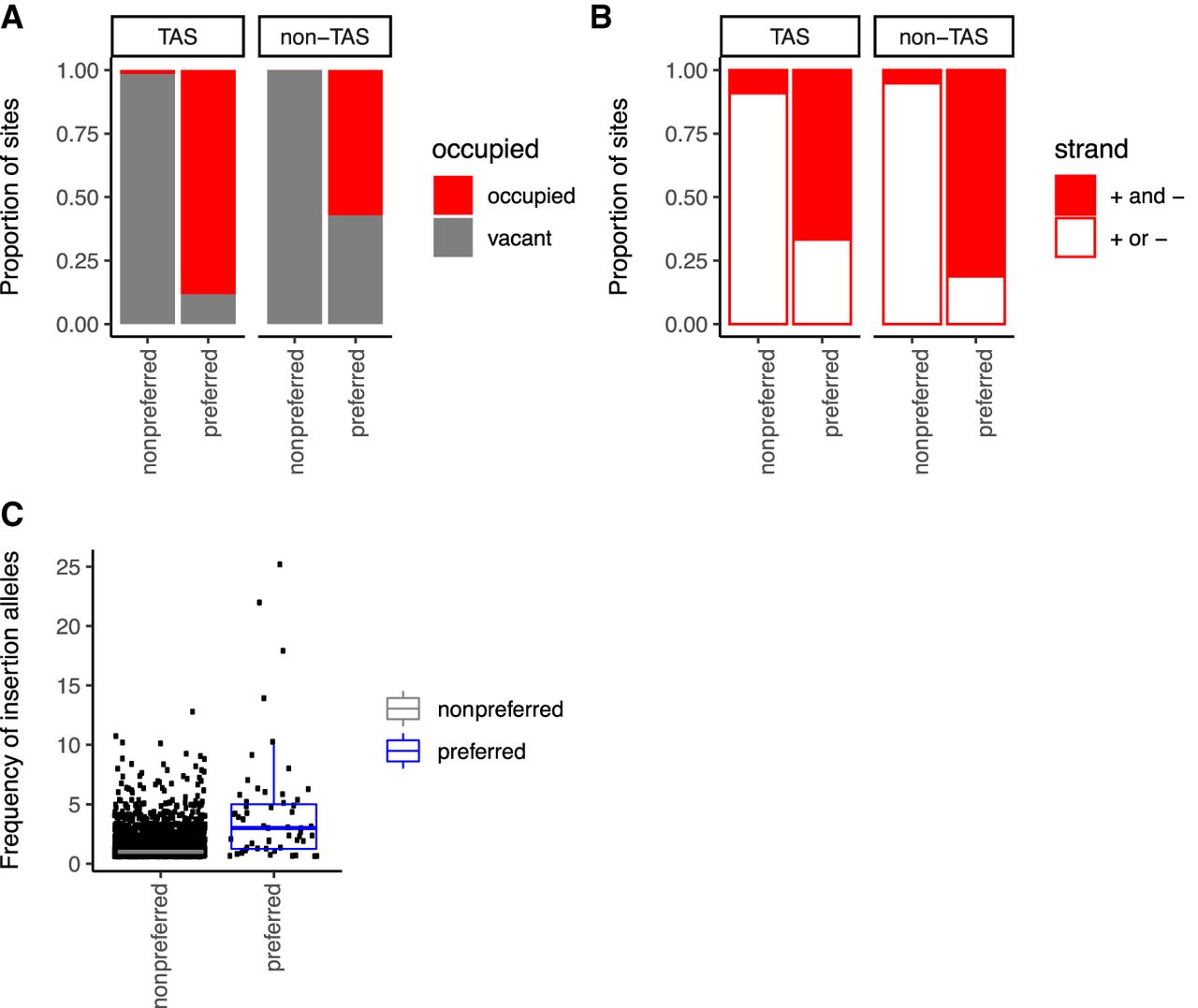
Figure 4.
Insertion hot points in TAS arrays contribute to the large number of high-frequency P-element insertion alleles. (A) The proportion of nonpreferred and preferred (hot point) sites that are occupied by a P-element insertion in at least one DGRP genome or vacant in all DGRP genomes. (B) The proportion of occupied sites containing P-element insertions in both the sense and antisense strands (red), or a single strand (white), for nonpreferred and preferred sites. (C) The comparison between frequencies of P-elements at nonpreferred and preferred sites. P-elements inserted at the same site but in opposite orientations were considered different insertions.



