


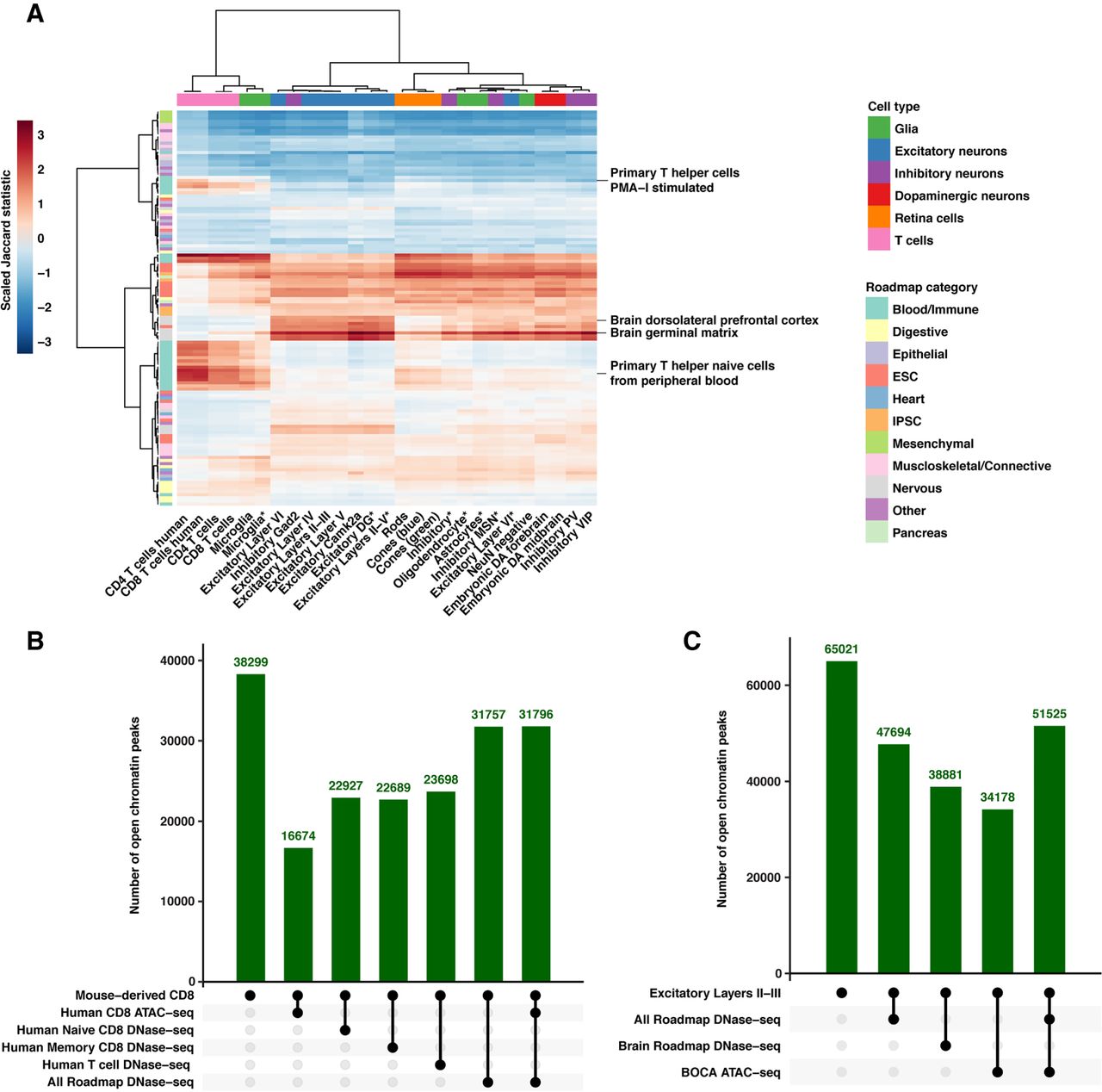
Mouse-derived human peaks serve as robust proxies for cognate human tissues. (A) A heatmap displaying the pairwise relationships between 27 mouse-derived ATAC-seq samples and imputed Roadmap Epigenomics Project open chromatin data from 127 tissues. Data displayed are the pairwise Jaccard statistic scaled by column (ATAC-seq sample). Data are hierarchical clustered by ATAC-sample and Roadmap tissue. Representative Roadmap tissues illustrating groups of immune and brain-derived tissues that are highlighted in the text are displayed. (IPSC) Induced pluripotent stem cells, (ESC) embryonic stem cell. (B) Plot displaying the intersection of mouse-derived CD8 T cell open chromatin peaks with publicly available human data sets. All numbers displayed are the number of mouse-derived peaks that meet the intersecting criteria below the plot. (C) Plot displaying the intersection of mouse-derived Excitatory Layers II-III open chromatin peaks with publicly available human data sets. All numbers displayed are the number of mouse-derived peaks that meet the intersecting criteria below the plot.



