


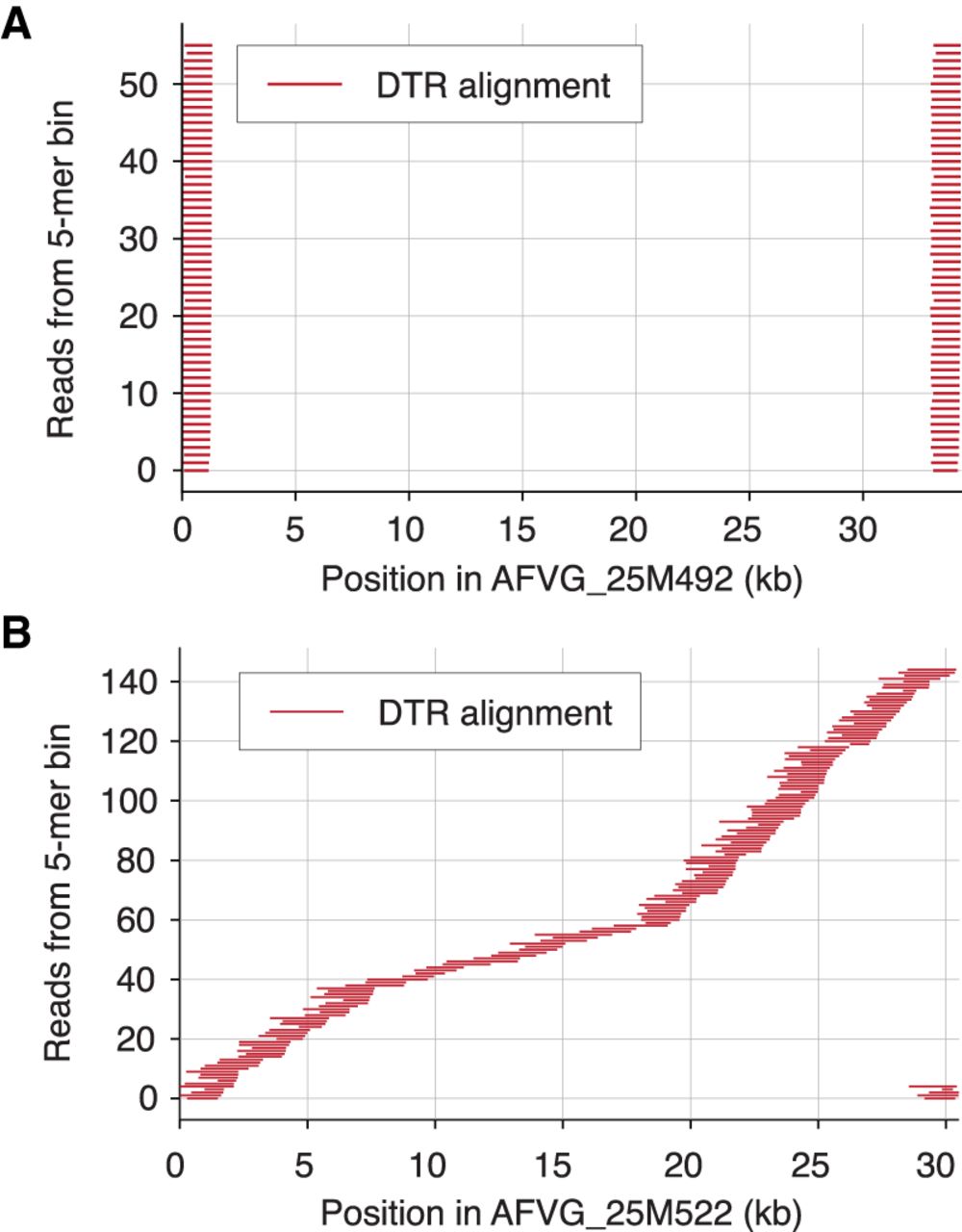
Aligned positions of DTR sequences in genomes. The DTR sequences can be either conserved (i.e., repeats all consist of the exact same genomic DNA subsequence) or circularly permuted (i.e., repeated termini sequences derive from different regions of the genome) depending on the mechanism used for phage DNA packaging. (A) DTR sequences flanking full-length genome reads in 5-mer bin 848 in the 25-m sample were aligned to a polished draft genome produced from that bin, AFVG_25M492, revealing that the DTR sequences were conserved across all reads and associated with fixed genomic positions. (B) DTR sequences from reads in 5-mer bin 903 in the same sample were aligned to a polished draft genome from that bin, AFVG_25M522. In this case, the DTRs were composed of sequences from throughout the genome instead of being associated with a single fixed subsequence. This observation reveals the circular permutation of the genome that is consistent with the “headful” mechanism of phage DNA packaging.



