


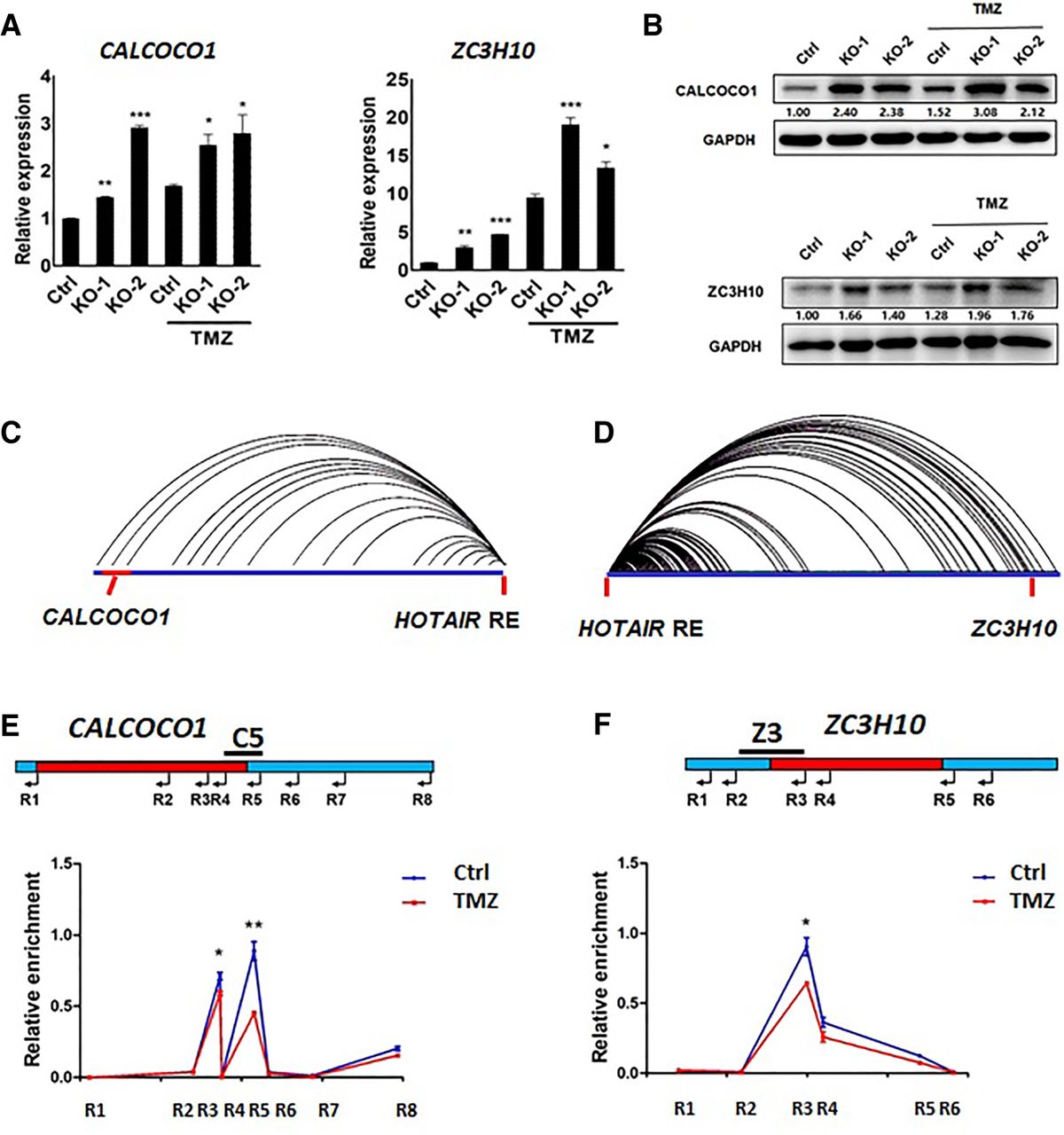
CALCOCO1 and ZC3H10 are potentially regulated by the HOTAIR regulatory element. (A) RT-qPCR analysis of mRNA (independent mRNA library) levels of potential target genes CALCOCO1 and ZC3H10. Data represent means ± S.E.M. of three independent experiments. (*) P < 0.05, (**) P < 0.01, (***) P < 0.001 compared with corresponding Ctrl cells. (B) Western blot analysis of CALCOCO1 and ZC3H10 in wild-type U251 cells (Ctrl) and HOTAIR regulatory element knockout U251 lines (KO-1, KO-2) that were treated with or without TMZ (1 mM, 72 h). Relative protein levels were quantified by using ImageJ. (C) Capture Hi-C loop view shows interactions between HOTAIR RE and CALCOCO1. (D) Capture Hi-C loop view shows interactions between HOTAIR RE and ZC3H10. (E) CALCOCO1-HOTAIR RE interaction analyzed by 3C assay in U251 cells treated with or without TMZ (1 mM, 72 h). Interaction frequency was calculated as described in the Methods. Data represent means ± S.E.M. of three independent experiments. (*) P < 0.05, (**) P < 0.01, compared with corresponding relative enrichment in U251 cells treated with TMZ. (F) ZC3H10-HOTAIR RE interaction analyzed by 3C assay in U251 cells treated with or without TMZ (1 mM, 72 h). Interaction frequency was calculated as described in the Methods. Data represent means ± S.E.M. of three independent experiments. (*) P < 0.05, compared with corresponding relative enrichment in U251 cells treated with TMZ.



