


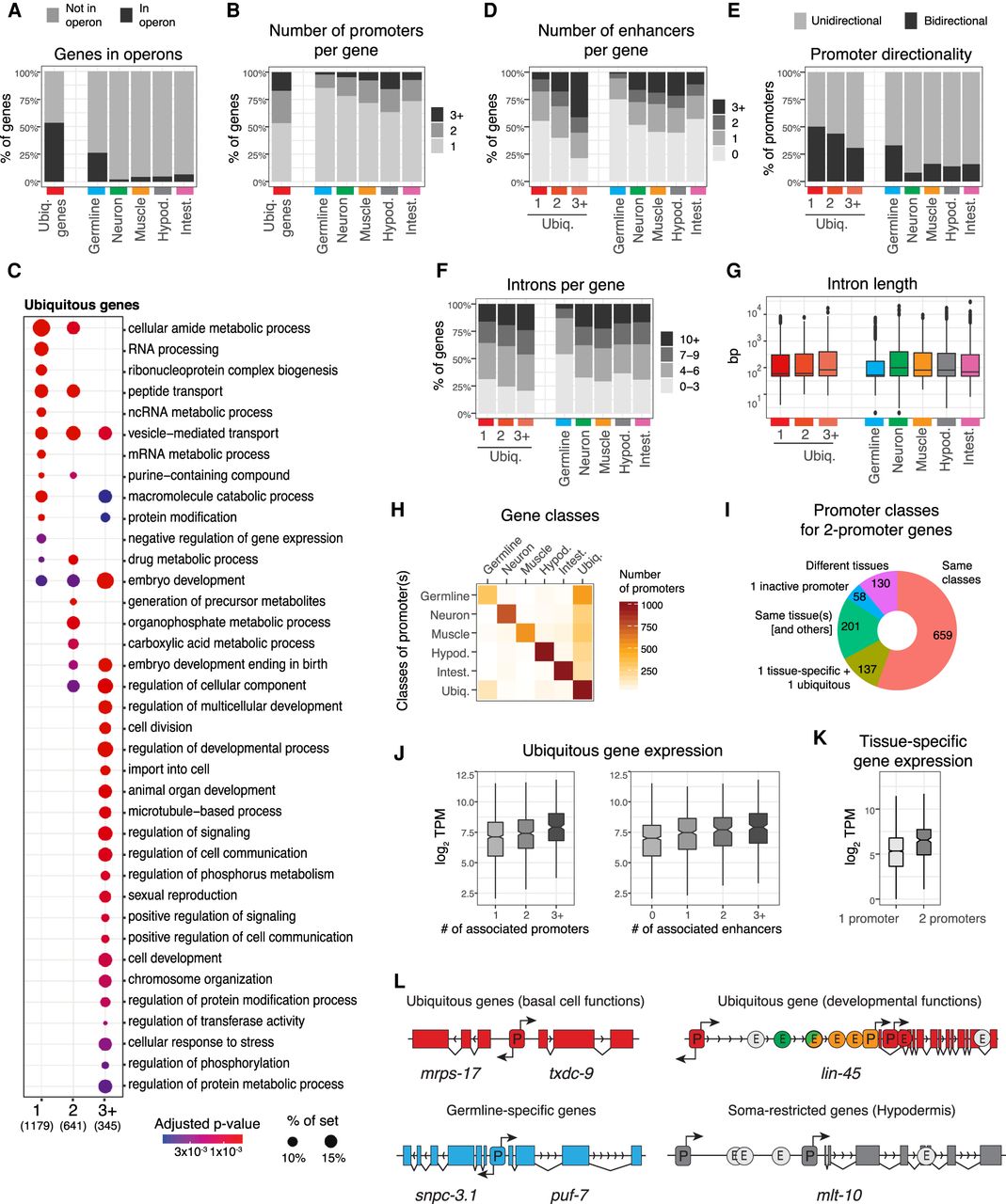
Regulatory architectures of ubiquitous, germline, and soma-restricted genes have distinctive features. (A) Percentage of genes organized in an operon for each gene class. (B) Percentage of genes with one, two, or three or more promoters for each gene class. (C) GO terms from Biological Process ontology enriched in ubiquitous genes with one, two, or three or more annotated promoters. (D) Percentage of genes with zero, one, two, or three or more enhancers associated with genes of each expression class. Only genes with at least one annotated promoter are considered. (E) Percentage of unidirectional or bidirectional protein-coding promoters for each gene class. (F) Percentage of genes with the indicated number of introns for each gene class. (G) Intron length for each gene class. (H) Classes of promoters associated with genes of each expression class. Only the major promoter classes are displayed. For all results, see Supplemental Table S2. (I) Concordance of promoter classes for genes with two promoters. (J) Gene expression levels in whole young adults for ubiquitous genes with one, two, or three or more promoters (left) or with zero, one, two, or three or more enhancers (right). (K) Gene expression levels of tissue-specific genes with one promoter or two promoters specifically active in the same tissue. In panels B through K, only first genes in operons and nonoperon genes were considered. (L, left) Examples of the simple regulatory architecture shared by ubiquitous genes and germline-specific genes. (Right) Examples of more complex architectures found at developmental ubiquitous genes (e.g., lin-45) or somatic tissue–specific genes (e.g., mlt-10).



