


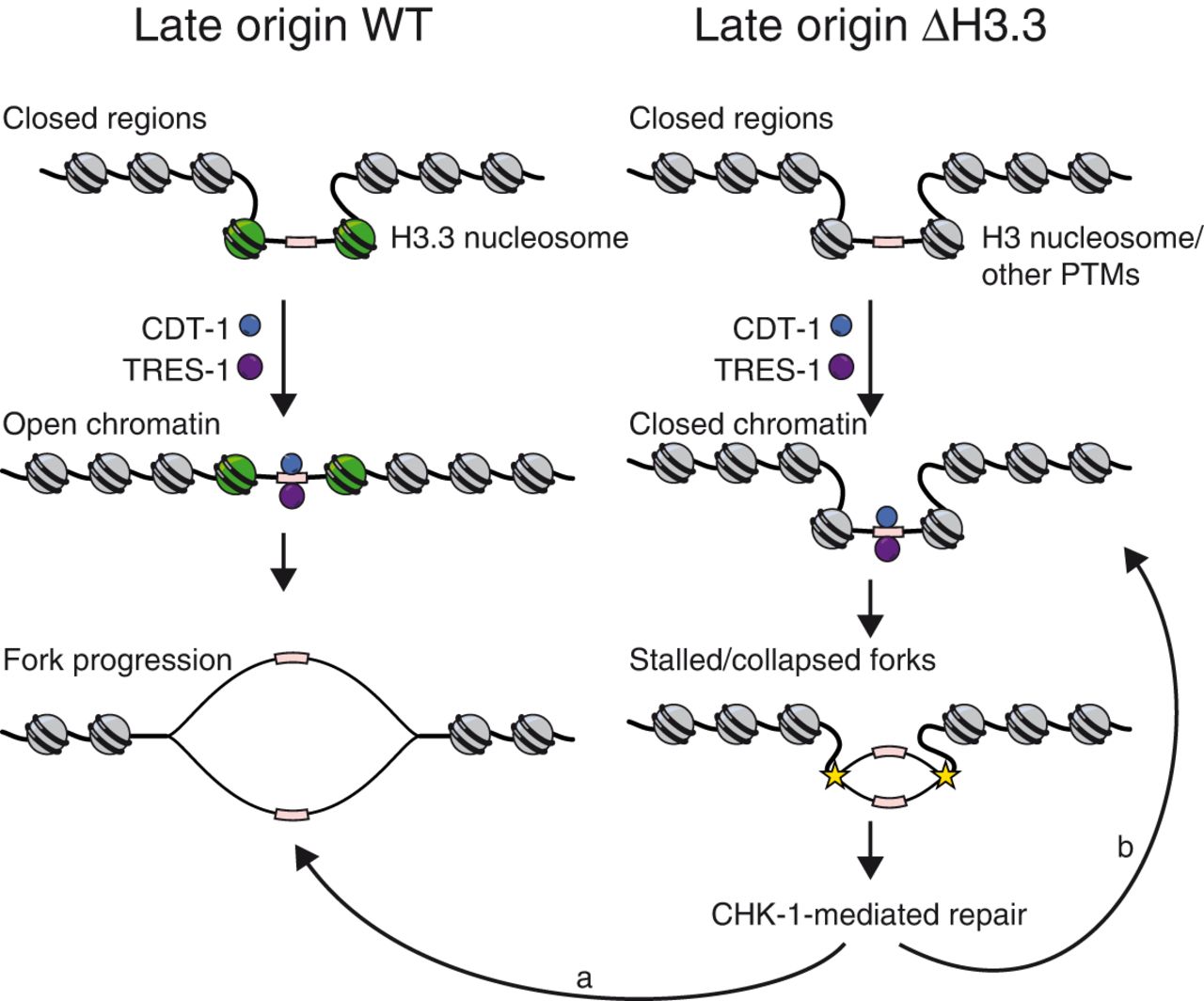
Figure 7.
Model for the role of H3.3 at late firing origins. Late origins tend to be located in regions of closed chromatin. In WT (left), the presence of H3.3 may facilitate the opening of the origin upon activation and replication fork progression away from the origin or may allow H3.3 to be efficiently recruited to sites of fork stalling. Upon loss of H3.3 (Δ H3.3; right), the opening of the chromatin context or fork restart after fork stalling may be impaired, leading to delays in fork progression. The replication stress is sensed by the CHK-1 checkpoint and enables damage repair and fork restart (b) and eventual fork progression as in WT (a).



