


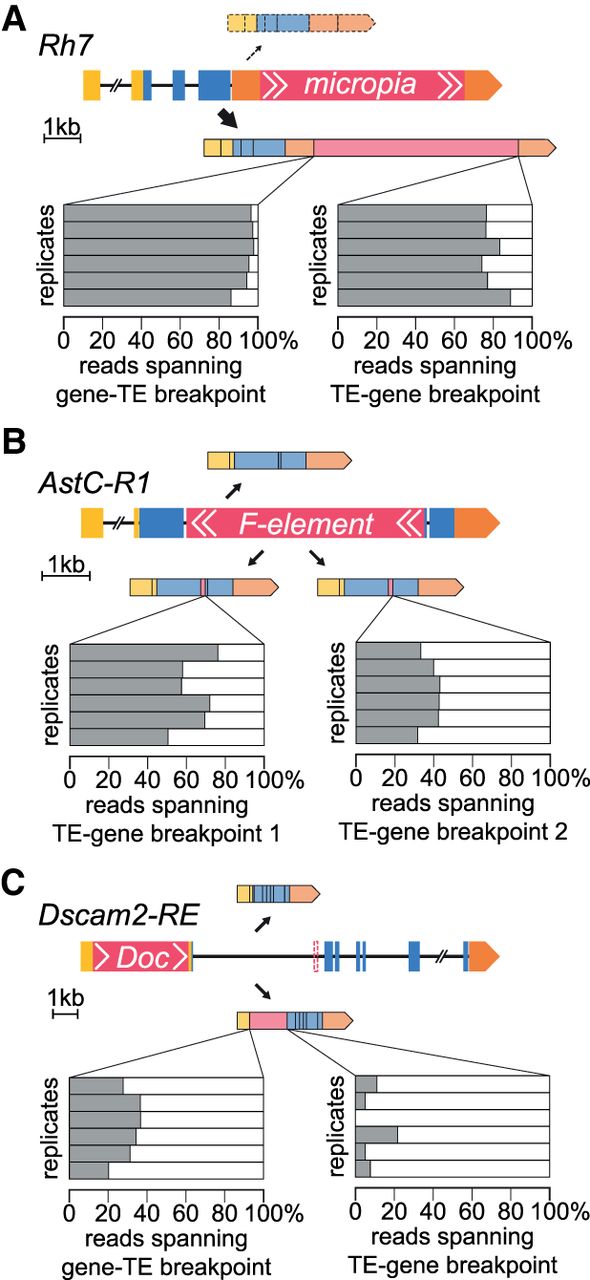
High penetrance of transposon-containing splice isoforms. (A) Schematic showing Rhodopsin 7 locus harboring a sense micropia in the 3′ UTR and two splice isoforms. Gray bars show percentage of reads spanning the gene-TE (left) and TE-gene (right) breakpoint in each of the six tested replicates. (B) The AstC-R1 gene harbors an antisense F-element immediately upstream of the second exon that introduces cryptic splice sites. Three spliced isoforms are shown. (C) Dscam2 harbors a sense Doc in its 5′ UTR (in addition to a blood insertion in its first intron) (Supplemental Fig. S6). For ease of visualization, only the shortest Dscam2 isoform, RE, is depicted. The blood insertion is indicated with a dashed box. See Supplemental Table S5 for complete list.



