


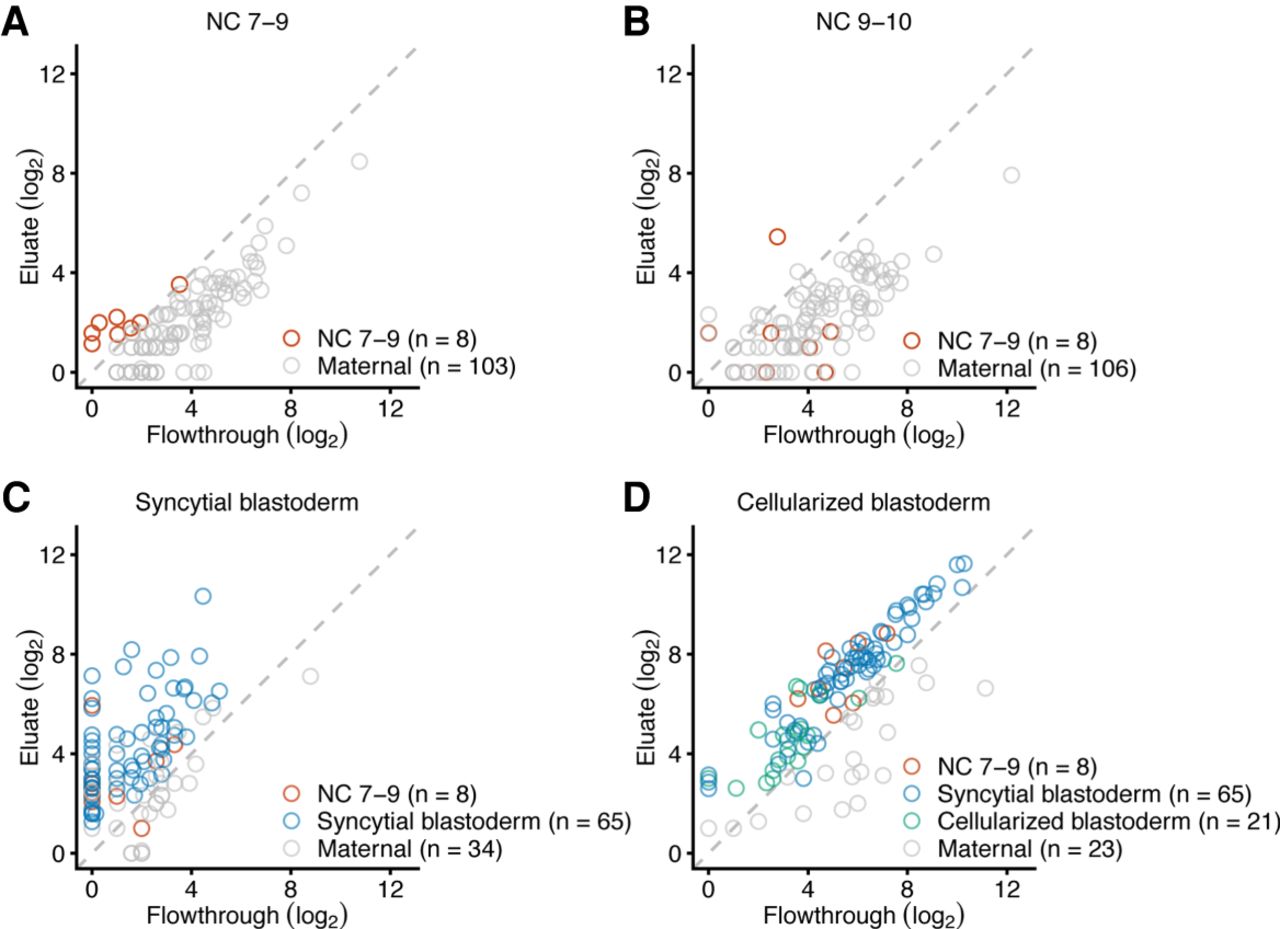
Two bursts of TE family expression. (A) Identification of eight TE families transcribed before pole-cell formation. Plotted for each gene is the level of mRNA in the eluate as a function of its level in the flowthrough when analyzing RNA harvested from embryos that spanned NC 7–9, prior to pole-cell formation. Results for eight TE families passing the threshold for annotation as zygotically transcribed are indicated (red), as are those with detected transcripts that did not pass the threshold (gray). All TE families with expression detected in NC 7–9 are plotted. (B) No additional TE families are transcribed when analyzing RNA harvested from embryos that spanned NC 9–10. Points for all TE families transcribed in the previous stage are shown in red and all TE families with expression detected in NC 9–10 are plotted. (C) Identification of 65 additional TE families transcribed in the syncytial blastoderm using RNA harvested from syncytial-blastoderm embryos. Points for TE families identified as zygotically transcribed in two biological replicates are colored, indicating in blue those not identified in a previous stage. (D) Identification of 21 additional TE families transcribed in the cellularized blastoderm using RNA harvested from cellularized-blastoderm embryos. Points for TE families identified as zygotically transcribed in two biological replicates are colored, indicating in green those not identified in a previous stage.



