


Cover image
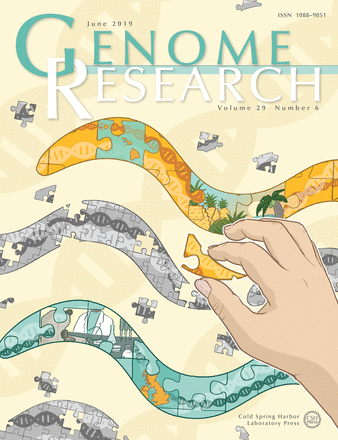
In this issue, newly assembled genomes of Caenorhabditis elegans using long-read sequencing data (represented by large puzzle pieces in colored worms) are presented. While short-read sequencing (represented by small puzzle pieces in gray-colored worms) has limitations in the assembly of a complete genome (represented by missing parts of the puzzle), long-read sequencing overcomes these limitations by allowing detection of complex repeat sequences and structural variations. Yoshimura and colleagues constructed the genome of the lab-derived reference strain of C. elegans (blue worm), leaving only two gaps in the entire genome sequence. Kim and colleagues built a nearly complete genome of a Hawaiian strain (orange worm), the most genetically diverse wild isolate compared to the reference strain, and discuss intra-species genomic variation and subtelomere evolution (the tail-shaped piece held in hand). (Cover artwork by Daisy S. Lim, daisylim@snu.ac.kr, and conceptually inspired by Jun Kim. [For details, see Kim et al. and Yoshimura et al., pp. 1023–1035 and 1009–1022.])

