


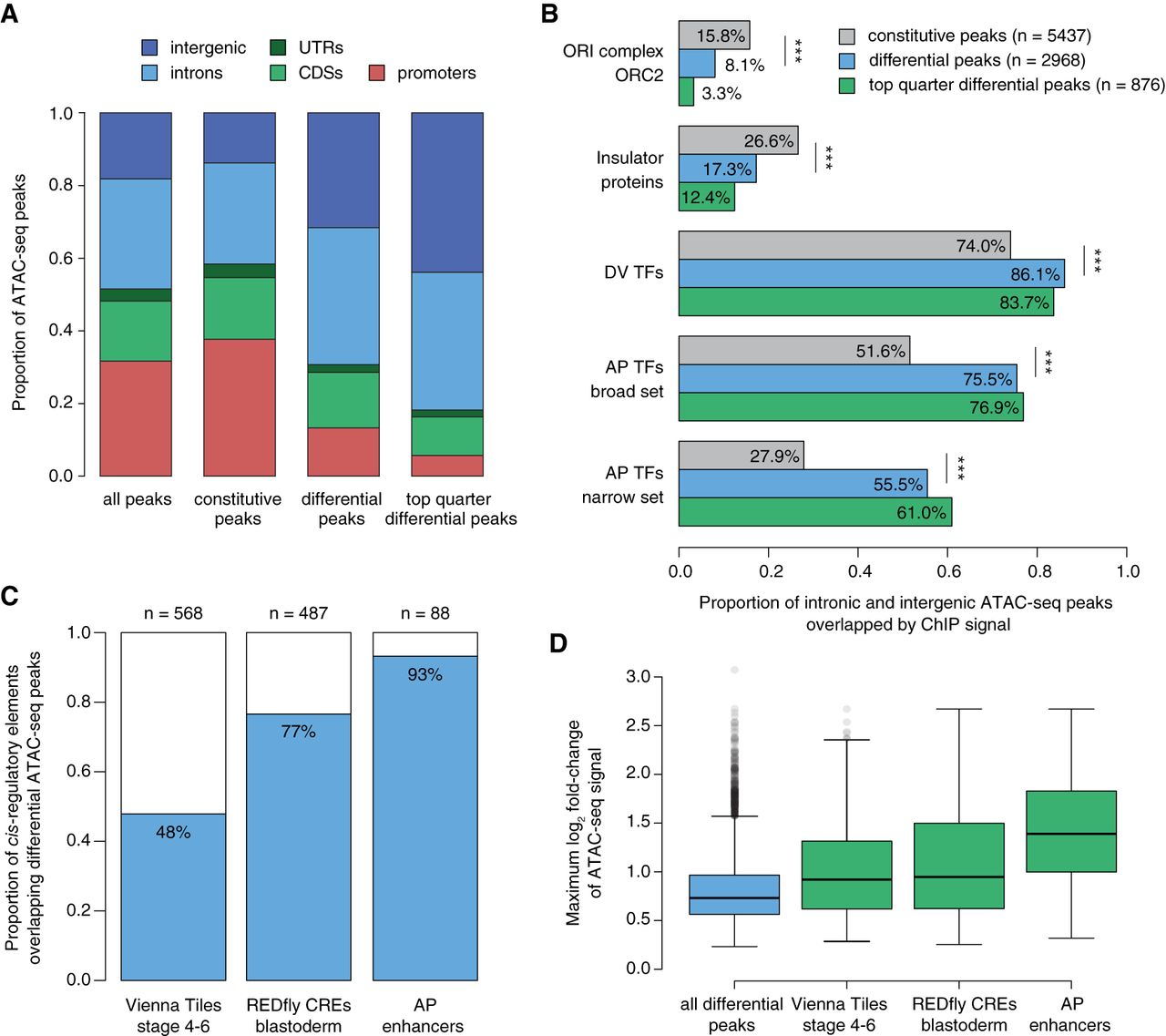
Differential ATAC-seq peaks display strong features of axis patterning enhancers. (A) Proportional distribution of genomic annotations among different classes of accessible regions: all high-confidence ATAC-seq peaks (all peaks), constitutive peaks, differential peaks, top quarter of differential peaks (highest values of maximum log2 fold-change reported in DESeq2) (Supplemental Fig. S10). (UTR) 5′ and 3′ untranslated regions, (CDS) coding sequence. (B) Bar plot shows the proportion of different classes of ATAC-seq peaks that map to intronic and intergenic regions (numbers of intervals in the legend) and colocalize with ChIP signal of different classes of proteins. (ORI complex) ChIP-seq peaks of ORC2 (origin recognition complex subunit 2) (Eaton et al. 2011), (Insulator proteins) ChIP-chip peaks of BEAF-32, CP190, CTCF, and Su(Hw) (Celniker et al. 2009), (DV TFs) ChIP-chip peaks of four maternal and zygotic DV TFs: Dorsal, Mothers against dpp, Snail, and Twist (MacArthur et al. 2009), (AP TFs [broad set]) ChIP-chip peaks of 14 maternal, gap, and pair-rule AP TFs: bicoid, caudal, giant, hunchback, knirps, Kruppel, huckebein, tailless, Dichaete, fushi tarazu, hairy, paired, runt, and sloppy paired 1 (Li et al. 2008; MacArthur et al. 2009), (AP TFs [narrow set]) ChIP-seq peaks of six maternal and gap AP TFs: Bicoid, Caudal, Giant, Hunchback, Knirps, and Kruppel (Bradley et al. 2010). Asterisks indicate significant differences between constitutive and differential peaks; (***) P < 0.0001, Fisher's exact test. (C) Bar plot shows the proportion of annotated CREs that overlap differential peaks. Total number of CREs from each category is indicated above the bars: Vienna Tiles (Kvon et al. 2014) active at stage 4–6, REDfly CREs (Gallo et al. 2011) active in blastoderm embryos, and AP enhancers driving patterned expression specifically along the AP axis (Supplemental Table S8). (D) Box plots show distributions of maximum log2 fold-change of accessibility signal reported for all differential peaks (blue) and differential peaks overlapping the three categories of annotated CREs (green).



