


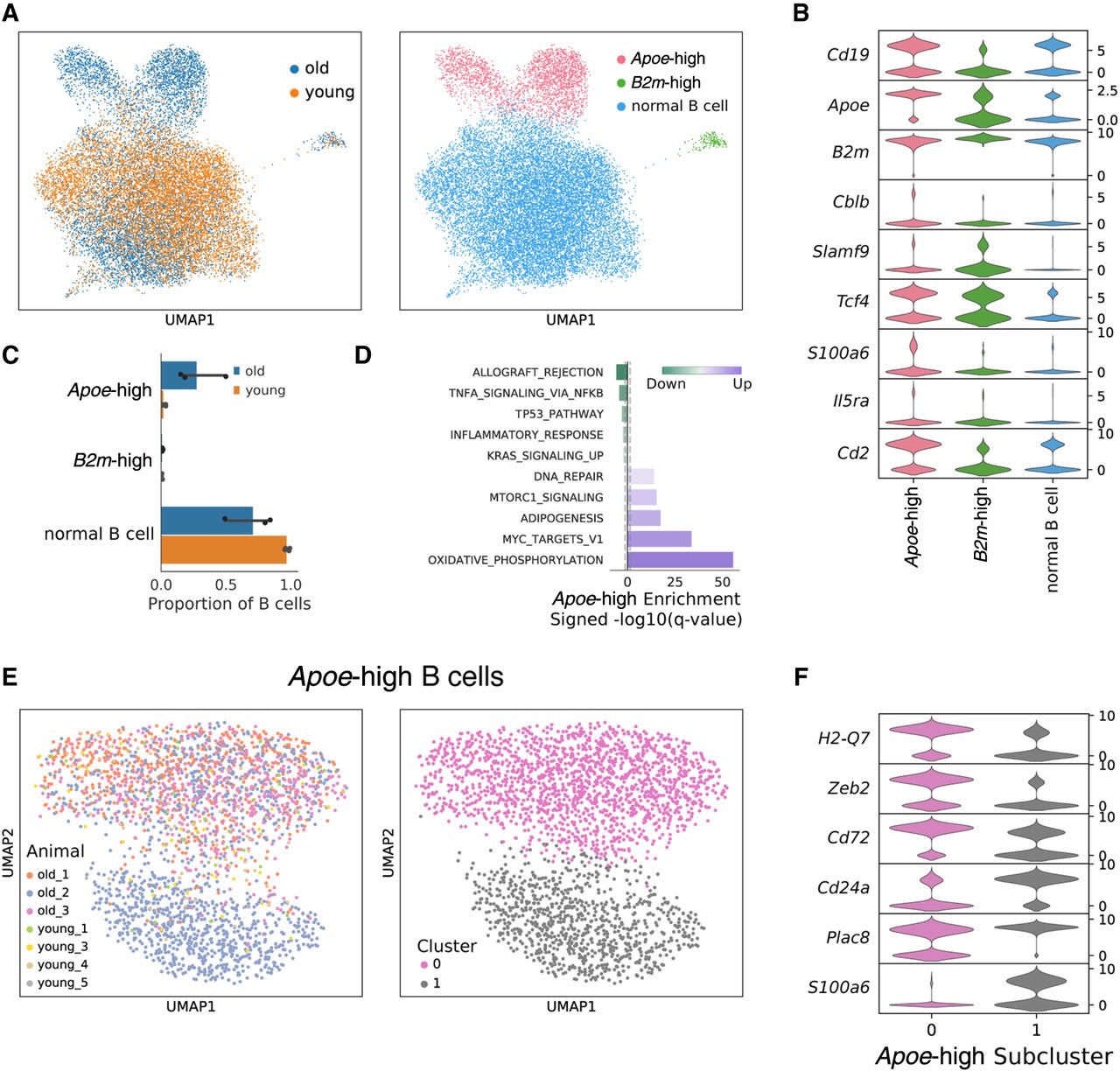
Aging manifests novel neoplastic B cell states in the spleen. (A) UMAP embeddings of the spleen B cell compartment, colored by age (left). Louvain clustering identified three subpopulations within the B cell compartment of the spleen, named by their marker genes (right). (B) Marker genes for each cluster and a set of lymphoma-specific genes presented as violin plots. All markers were significantly enriched in the Apoe-high and B2m-high cluster. (C) Proportions of cells in each cluster as a function of age. The Apoe-high and B2m-high states are occupied predominantly by aged cells (t-test on ALR-transformed proportions, Q < 0.05). (D) Enrichment of MSigDB Hallmark gene sets based on differentially expressed genes in the Apoe-high cluster relative to the normal B cell cluster. Myc targets, mTOR signaling, and DNA repair pathways were up-regulated, whereas TRP53 signaling was down-regulated, suggesting neoplasia. Gray dotted lines represent the α = 0.05 significance threshold. (E) UMAP embedding of the Apoe cell cluster alone. A second Louvain clustering iteration reveals two clusters within this Apoe-high group (right). Visualizing the animal of origin for each cell, it is apparent that Cluster 1 is dominated by a single old animal (left). (F) Marker genes for each of the subclusters within the Apoe-high state presented as violin plots. Cluster 0 is enriched for lymphoma-associated gene Zeb2, and Cluster 1 is enriched for Plac8. These results similarly suggest neoplasia.



