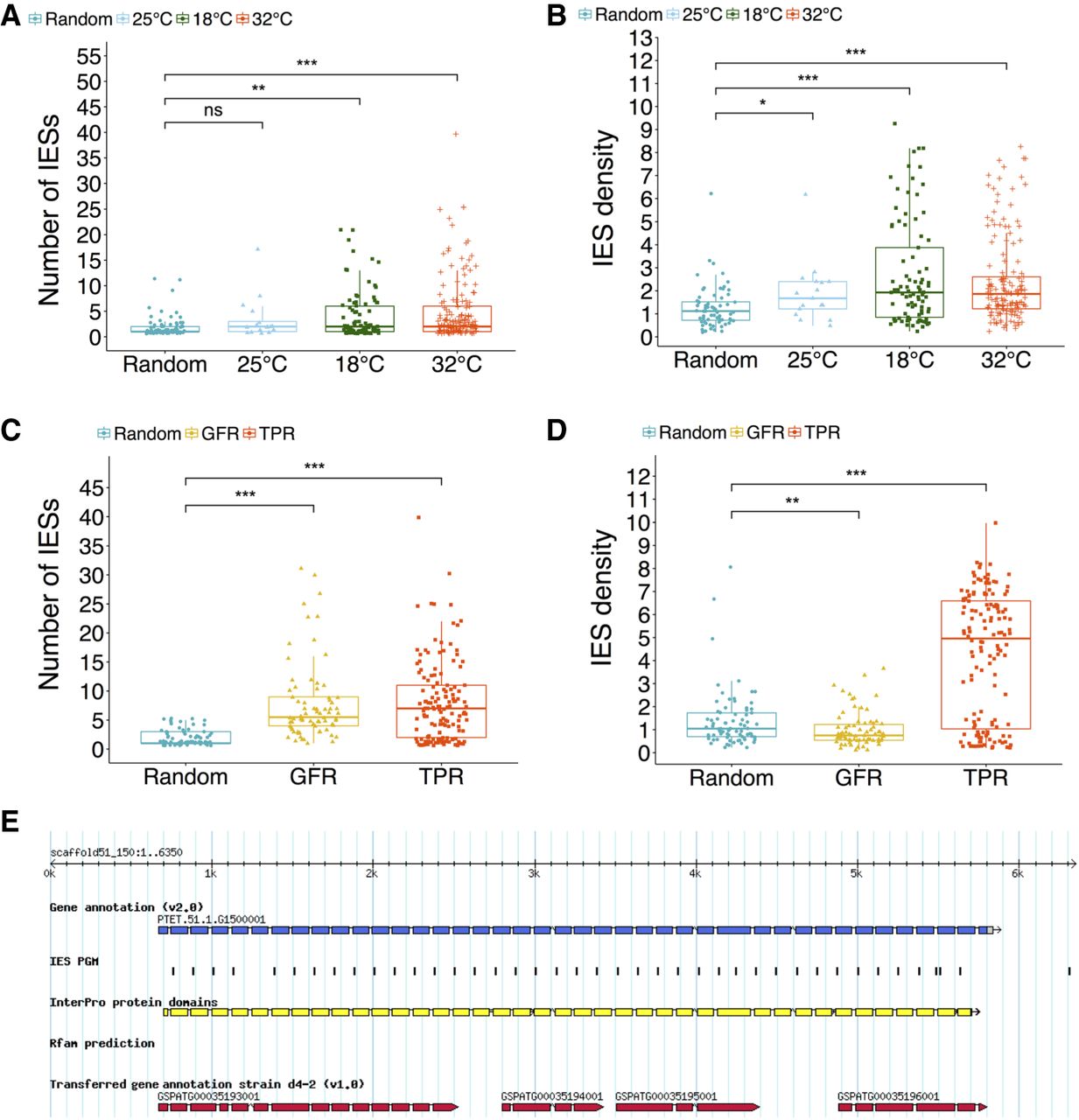
TPR-motif and GFR Cys-rich domain-containing proteins are IES-rich gene families susceptible to inefficient IES excision in response to temperature changes during autogamy. (A) Genes affected by IES retention at 18°C and 32°C have a significantly greater than average number of IESs. (B) Across all the investigated temperatures, genes hit by significant IES retention are IES dense. (C) TPR and GFR proteins show extraordinary per-gene IES counts. (D) TPR but not GFR proteins are characterized by elevated IES density (Wilcoxon rank-sum test: [ns] P > 0.05; [*] P < 0.05; [**] P < 0.01; [***] P < 0.001). (E) A TPR-motif gene (PTET.51.1.G1500001) showing a characteristic pattern of IES distribution. This gene is hit by multiple IES retention at 32°C. IESs are positioned almost invariably at the 5′ end of the TPR coding exons. According to the v2.0 annotation of macronuclear gene models, PTET.51.1.G1500001 is the gene with the greatest number of IESs to be found in the P. tetraurelia genome. (TPR) Tetratricopeptide repeat region motif (IPR019734); (GFR-Cys-rich) growth factor receptor cysteine-rich domain (IPR009030); (IES density) number of IESs per kb.