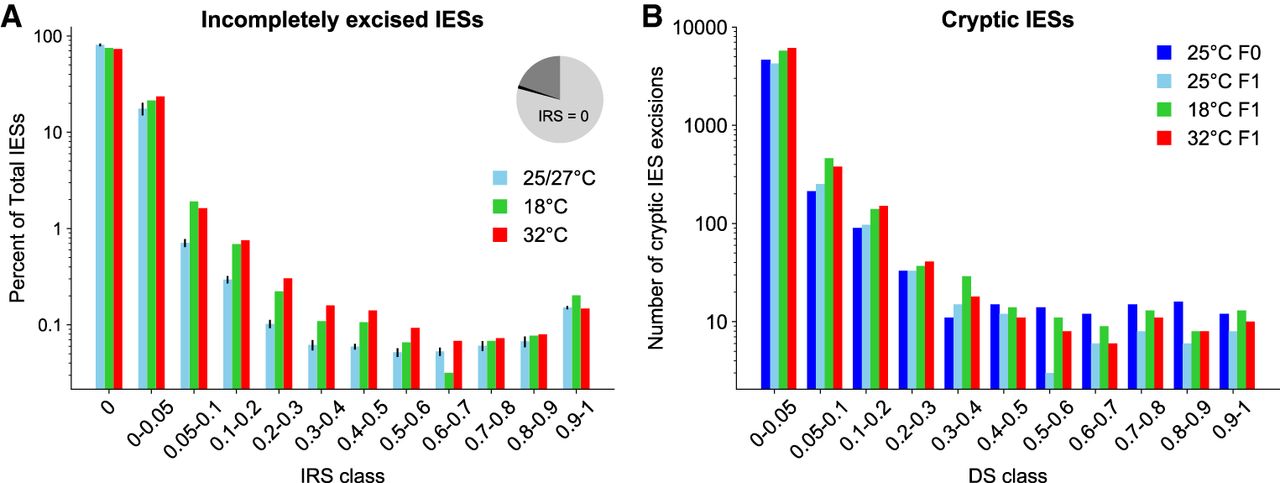
The rate of incomplete IES excision and somatic DNA deletion is temperature dependent. (A) The percentage of incompletely excised IESs is larger at 18°C and 32°C in comparison with the control lines grown at 25°C–27°C for several IRS classes. The pie chart shows the relative proportions of somatic IESs (IRS > 0.1; black), the fraction of incompletely excised IESs with 0 < IRS < 0.1 (dark gray), and the fraction of completely excised IESs (light gray). IES counts (reported in percentages, log scale) for the control group (n = 6 genomes) are averages ± the standard error of the mean. (B) TA-bounded somatic deletions (Cryptic IESs) tend to be relatively more frequent (absolute numbers, log scale) when PDE occurs at suboptimal temperatures. (IESs) internal eliminated sequences; (IRS) IES retention score; (DS) deletion score.