


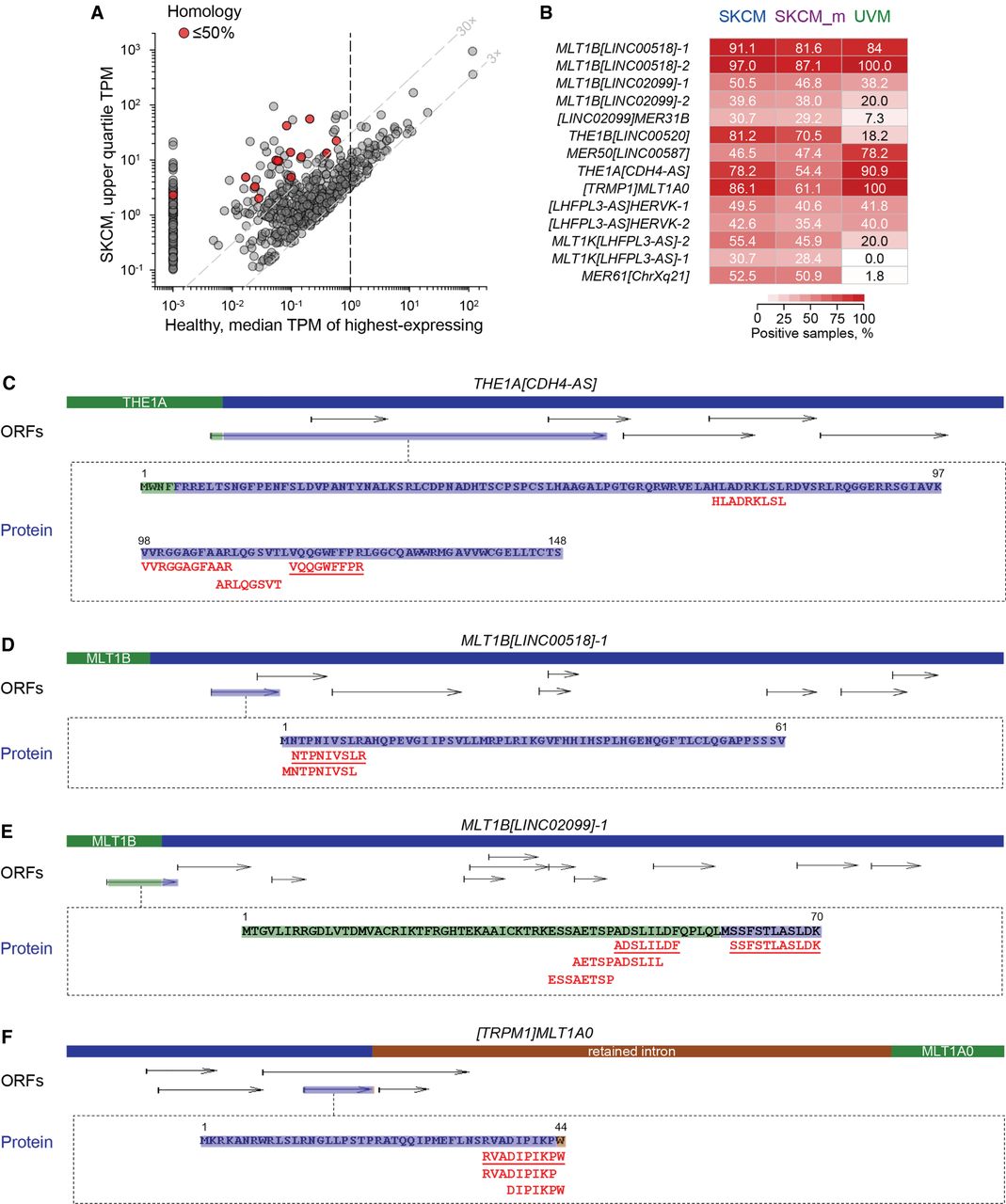
Potential antigenicity of SKCM-specific CLTs. (A) Properties of selected CLTs (red circles) with unique protein-coding potential. Plotted is the expression level of SKCM CLTs with a predicted ORF ≥300 nt, in SKCM (upper quartile TPM) against the median TPM of the highest-expressing healthy tissue. Although the cut-off for CLT selection was ≤85% homology over the entire ORF length with any other ORF potentially expressed in healthy tissues, the final selected CLTs displayed 0%–50% homology. (B) Prevalence of expression of the indicted CLTs with unique protein-coding potential among primary SKCM (n = 101), metastatic SKCM (SKCM_m; n = 342), or UVM (n = 55) patients. Values are the percentages of patient that express each CLT at 0.5 or more TPM. (C–F) CLT structure, all predicted ORFs >75 nt (ORFs), where the ORF with evidence for translation is highlighted, and amino acid sequence of the latter ORF. Also shown is the sequence of MHC-eluted peptides uniquely mapping to each CLT product. Underlined peptides were confirmed by comparison with synthetic peptides.



