


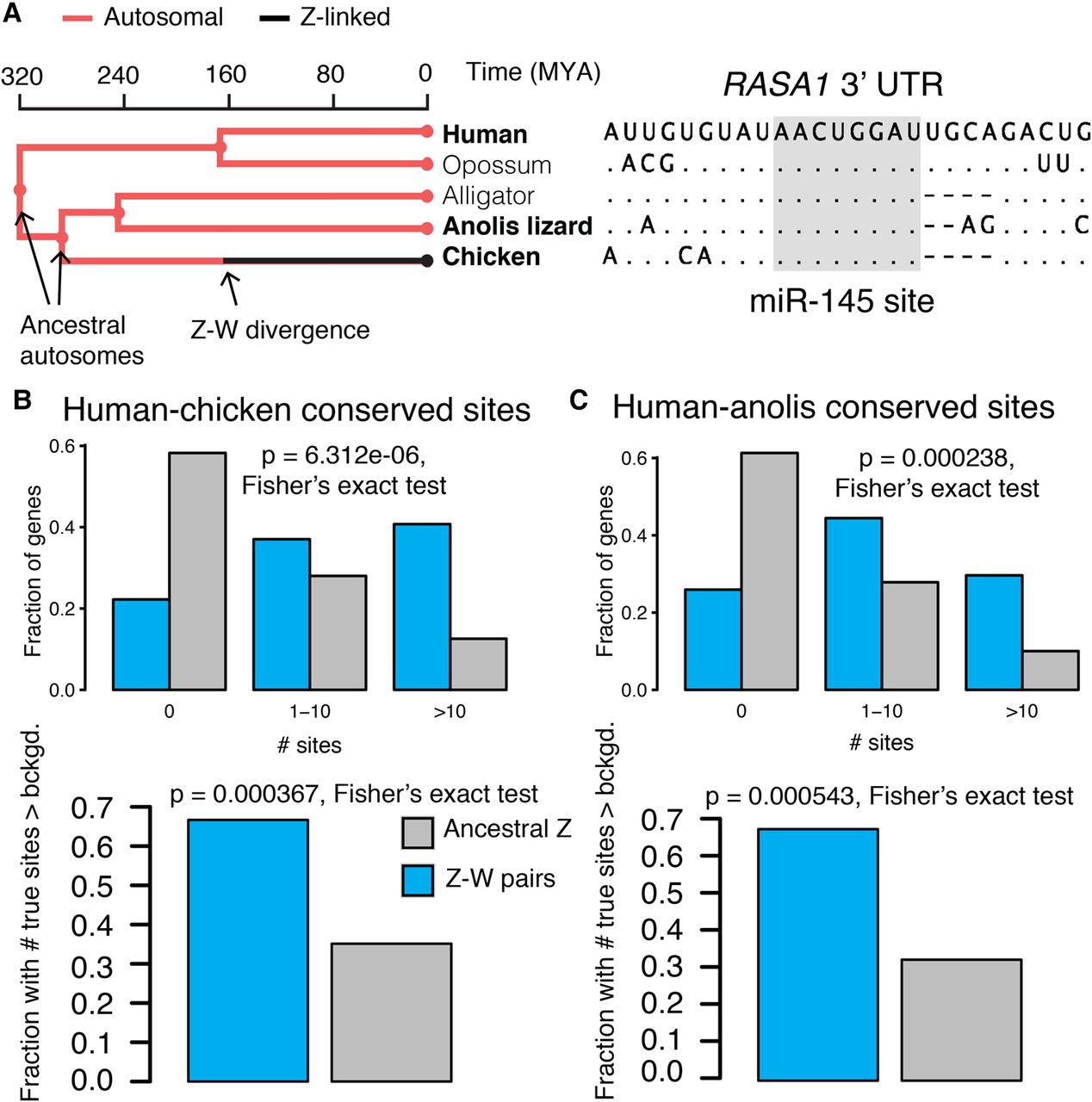
Heterogeneities in Z-linked miRNA targeting were present on the ancestral autosomes. (A) Example reconstruction of an ancestral miR-145 target site in the 3′ UTR of RASA1, a Z-linked gene with a surviving W homolog. (Left) Species tree overlaid with events in avian sex chromosome evolution. (Right) Multiple sequence alignment; dots in nonhuman species indicate identity with human sequence; dashes indicate gaps in alignment. (B) Numbers of sites conserved between 3′ UTRs of human and chicken orthologs (top) or comparisons to background expectation (bottom) for chicken Z-W pairs (n = 27) and other ancestral Z genes (n = 578). (C) Statistics as in B, but using sites conserved between human and Anolis 3′ UTRs.



