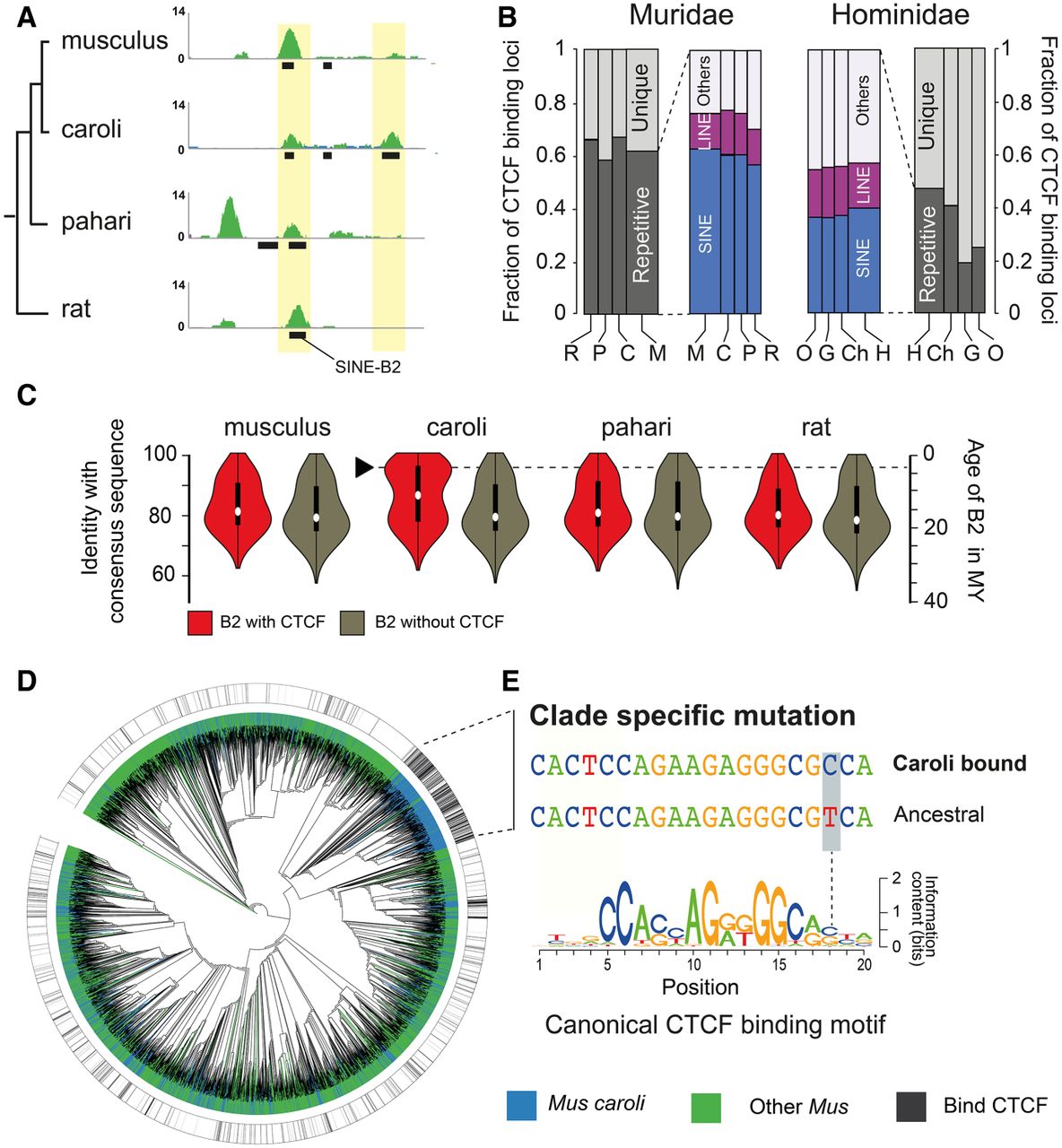
A single nucleotide mutation in a Mus caroli–specific expanding SINE B2 element contributed to the creation of thousands of novel CTCF binding events. (A) CTCF occupancy in the genome is shown by green tracks. The black squares show the location of SINE B2 retrotransposons. The yellow boxes represent two examples of a SINE B2 occupied by CTCF. (B) Fraction of transposable elements with CTCF binding in both Muridae (left) and Hominidae (right): (M) Mus musculus; (C) Mus caroli; (P) Mus pahari; (R) rat; (H) human; (Ch) chimpanzee; (G) gorilla; (O) orangutan. (C) Identity plots of SINE B2 with their consensus sequence, either occupied by CTCF (red) or not (brown) (Supplemental Methods SM4.1). The black arrow indicates a recent wave of SINE B2 expansion carrying CTCF binding sites in Mus caroli. (D) Neighbor-joining tree of SINE B2_Mm1 sequences from the three Mus species. The blue branches represent sequences from Mus caroli. The green branches represent sequences from Mus musculus or Mus pahari. The black lines in the outside tracks indicates the presence of a CTCF binding event. (E) A single nucleotide variation exists between the ancestral CTCF binding motif carried by the SINE B2_Mm1 element (middle) and a CTCF binding motif (top) carried by the elements recently expanded in Mus caroli. This branch-specific motif is enriched in CTCF occupancy.