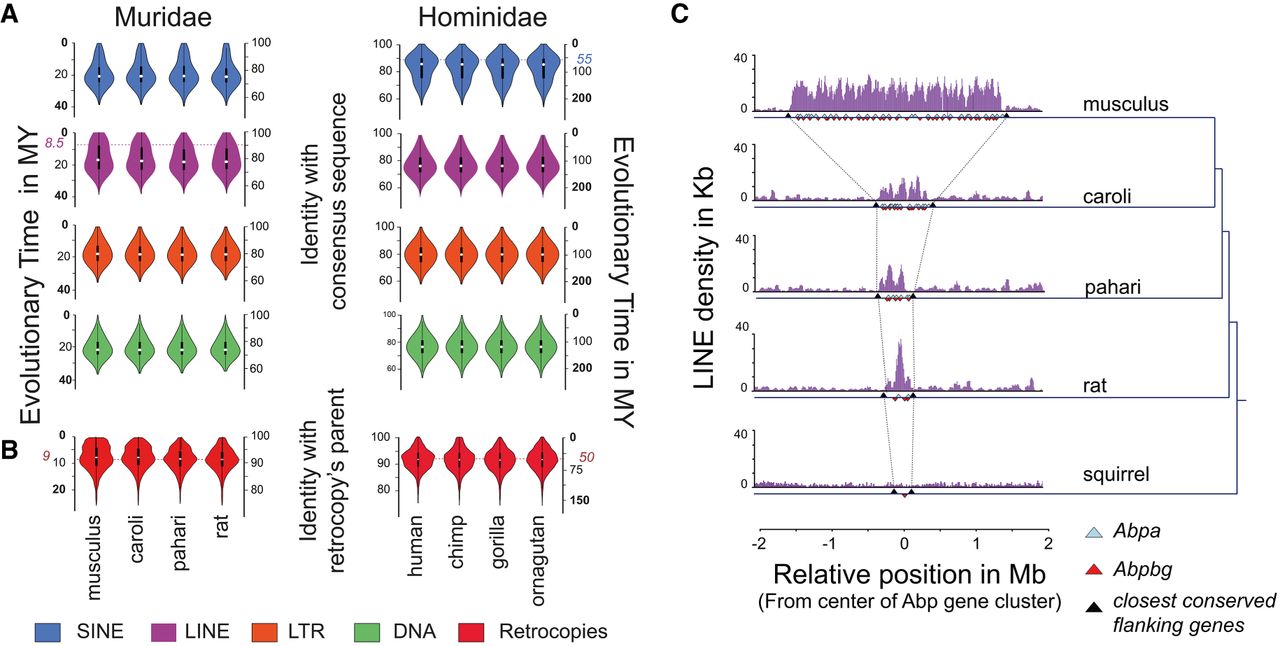
Recent LINE activity can remodel protein-coding gene loci. (A) Violin plots showing the distribution of repeat elements that have the indicated divergence from the ancestral element sequence: (blue) SINE; (purple) LINE; (orange) LTR; (green) DNA. The age of the transposable elements was estimated using the nucleotide divergence from ancestral SINE, LINE, LTR, and DNA elements (Supplemental Methods SM4.1). The dashed lines indicate the estimated peaks of the most recent expansions in Mus musculus and human. (B) Violin plots showing the distribution of retrocopies (red) that have the indicated divergence from their parental genes for each Muridae (left) and Hominidae (right) species. The age of the retrocopies was estimated by the nucleotide divergence from ancestral retrocopies and the corresponding parental genes (Supplemental Methods SM4.3). The dashed line indicates the peak of the most recent expansion in Mus musculus. (C) Representation of the density of LINE elements in the Abp gene cluster for Mus musculus, Mus caroli, Mus pahari, the rat, and the thirteen-lined ground squirrel. The blue and red triangles represent the Abp genes: (blue) Abpa (Scgb1b); (red) Abpbg (Scgb2b). The black triangles represent the closest flanking genes (upstream [Scn1b] and downstream [Gpi1]) shared by the four Muridae species and the squirrel.