


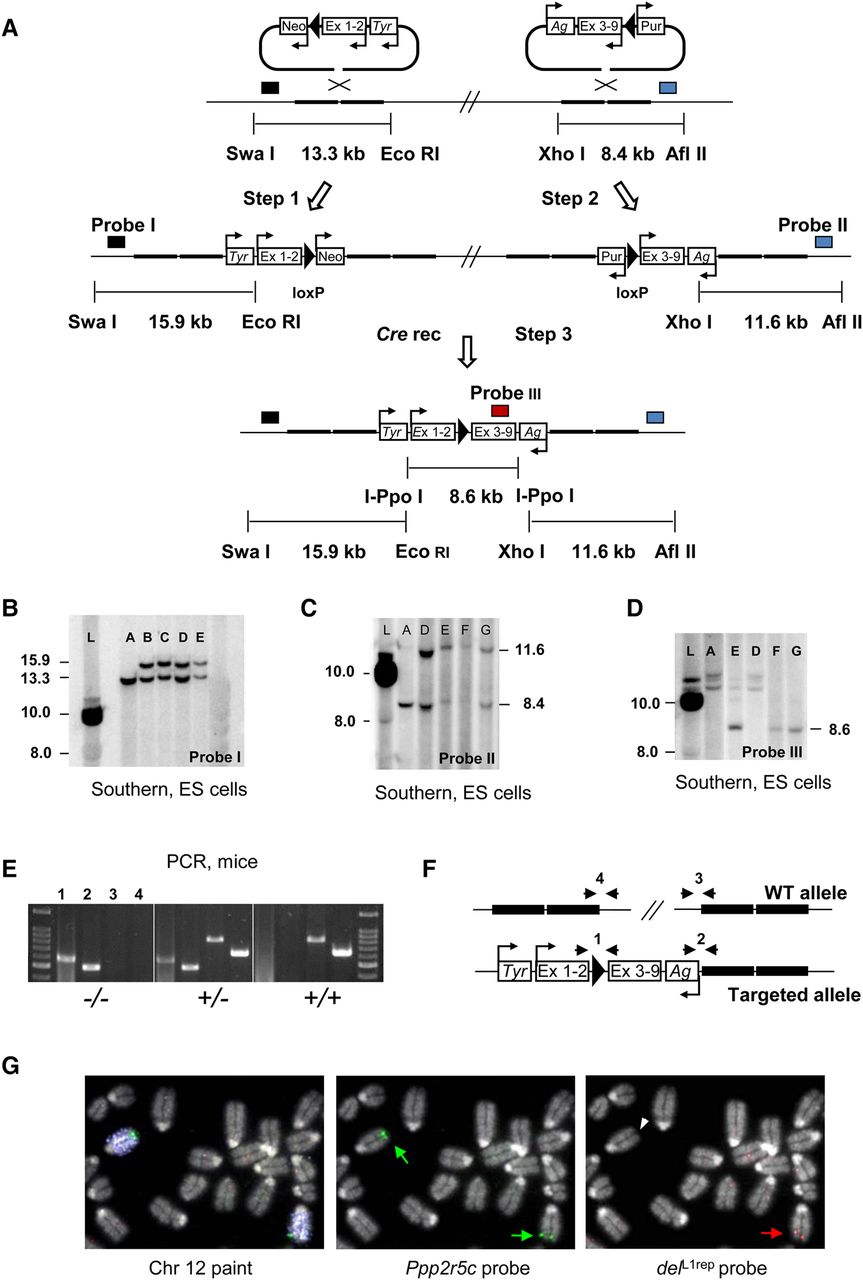
Targeting of 260 kb encompassing the LINE-rich repeat array: molecular and cytogenetic characterization of the delL1rep allele. (A) Complementary MICER vectors (Adams et al. 2004) were consecutively integrated into the genome by homologous recombination in embryonic stem (ES) cells. Ex 1–2 and ex 3–9 correspond to the split Hprt minigene exons in the 5′ and 3′ vectors, respectively. After expression of Cre, the loxP elements recombine excising the intervening sequence and reconstituting the Hprt mini-gene, which results in resistance to hypoxanthine/aminopterin/thymidine (hat). Mini-genes for the coat color markers agouti (Ag) and tyrosinase (Tyr) are shown. The location and direction of promoter elements is indicated by arrows. Probes used for Southern hybridizations are indicated by boxes. Positions of restriction sites and the sizes of WT and targeted alleles are also shown. (B–D) Southern hybridization blots of ES cells at Step 1 (B), Step 2 (C), and Step 3 (D). (L) ladder. (A) wild type; (B,C) 5′ vector-targeted; (D) double-targeted (5′ and 3′ vectors). (E–G) Distinct delL1rep (Cre-recombined) clones. (E) PCR genotyping of tail DNA of representative animals. (F) Schematic illustration of the respective assays. Primers pairs (1–4) used for screening are indicated by arrowheads. (G) Representative images of DNA FISH on metaphase spreads of mutant ES cells with BAC probes complementary to sequence within (delL1rep) and downstream (Ppp2r5c) from the deleted interval. The Ppp2r5c region (1 Mb downstream from the deletion) is identified in both Chromosome 12 homologs (green arrows), whereas the repeat region is seen in one homolog (red arrow) and is absent from the other (white arrowhead).



