


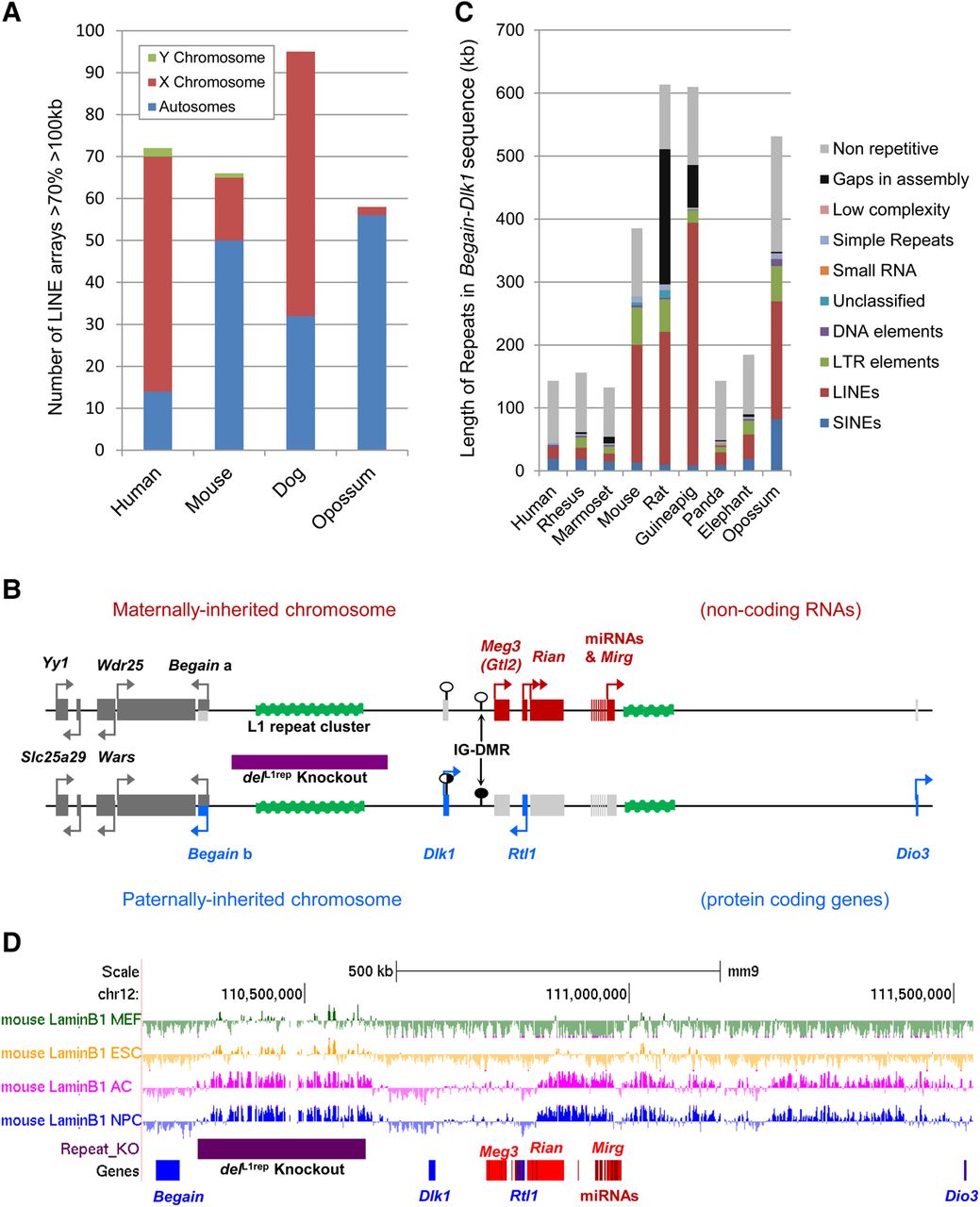
Distribution of LINE-rich arrays in mammalian genomes and identification of a large, intergenic LINE-rich repeat array in the mouse Dlk1-Dio3 imprinted gene cluster. (A) Chromosomal distribution of LINE-rich arrays of >70% LINE over >100 kb in the human, mouse, dog, and opossum genomes. In the mouse genome, LINE-rich arrays of >70% LINE extending over 100 kb are associated with vomeronasal and olfactory receptor genes. (B) The LINE-rich repeat cluster (green) is flanked by the Dlk1-Dio3 imprinted domain. Maternally expressed noncoding transcripts are shown in red, and paternally expressed protein coding genes are shown in blue. On the maternally inherited chromosome, noncoding RNAs Meg3 (Gtl2), Rtl1 anti-sense (AS), Rian, and microRNA-containing Mirg (red) are transcribed, whereas the protein-coding genes (light gray) are repressed. The paternally inherited chromosome expresses protein-coding Begain variant 1b, Dlk1, Rtl1, and Dio3 (blue), and silences the transcription of the noncoding RNAs (light gray). The imprinting control region (IG-DMR) and the Dlk1 DMR are unmethylated on the maternally inherited chromosome (white circles), and hypermethylated/partially methylated, respectively, on the paternally inherited chromosome (black and shady gray circles). Biallelic genes are shown in dark gray, and arrows denote the direction of transcription. (C) The total repeat coverage in the Begain-Dlk1 intergenic region in nine mammalian species illustrates the accumulation of LINE elements in the rodent lineage. Repeat content was ascertained using the RepeatMasker web server (Smit et al. 2015). (D) The mouse Dlk1-Dio3 intergenic LINE array between Begain and Dlk1 (purple bar) coincides with a facultative lamina-associated domain (fLAD) in astrocytes and neural precursor cells (Peric-Hupkes et al. 2010). Image taken from UCSC Genome Browser (Kent et al. 2002).



