


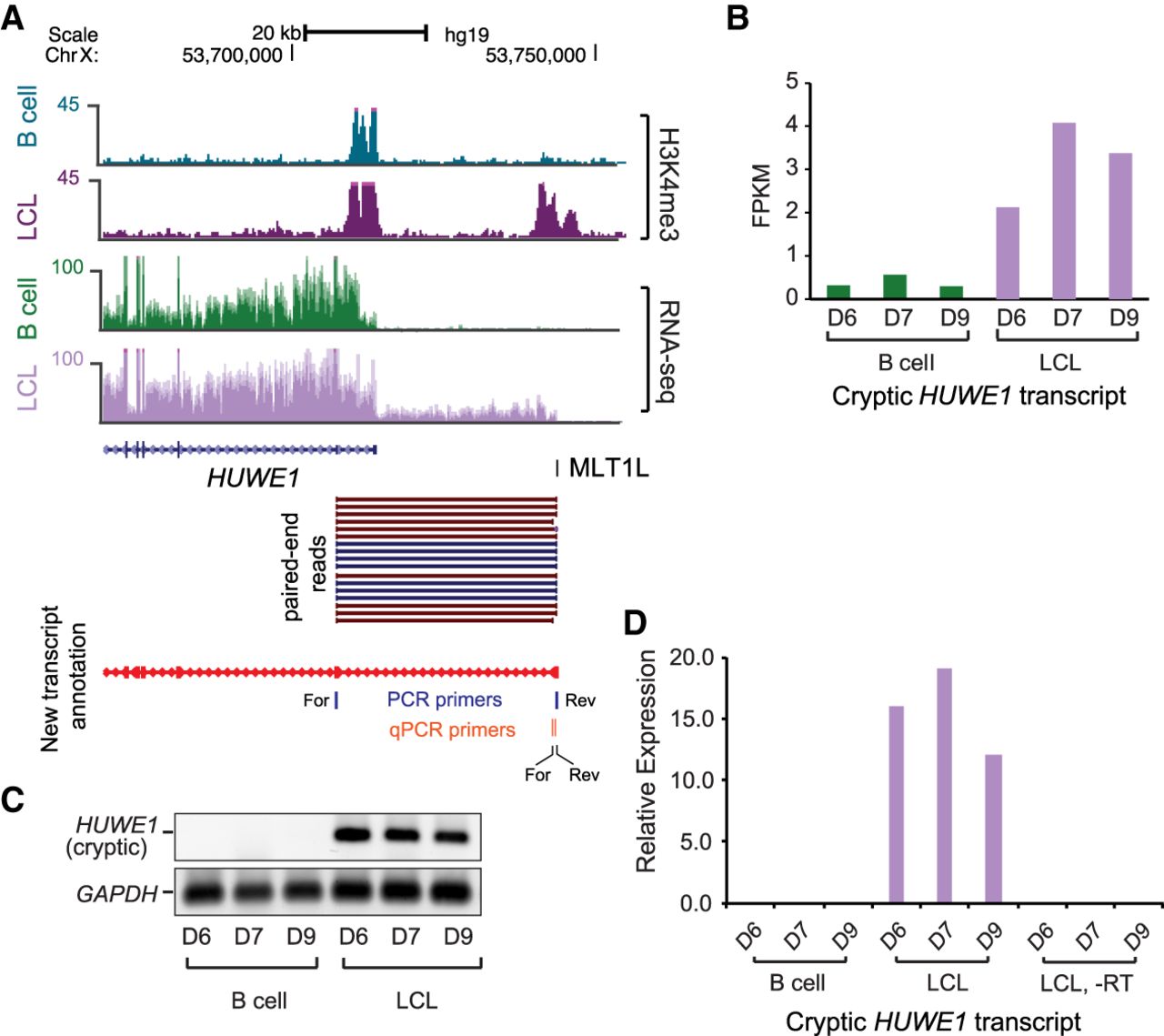
Activated LTRs can drive transcription of cryptic transcripts relevant to cancer. (A) Genome browser tracks for H3K4me3 and RNA-seq profile for B cells and LCLs at HUWE1/HECTH9 locus. Shown in red is the cryptic transcript assembled with the supporting paired-end reads from RNA-seq data set. TSS of alternative cryptic transcript overlaps MLT1L. Below transcript annotation are the PCR primers used for RT-PCR (blue) and qPCR (orange). (For) Forward primer; (Rev) reverse primer. (B) Fragments per kilobase per million reads (FPKM) in each RNA data set. (C) RT-PCR analysis of cryptic HUWE1 transcripts in B cells and matched LCLs. (D) RT-qPCR analysis of cryptic HUWE1 expression in B cells and LCLs. (-RT) no reverse transcriptase.



