


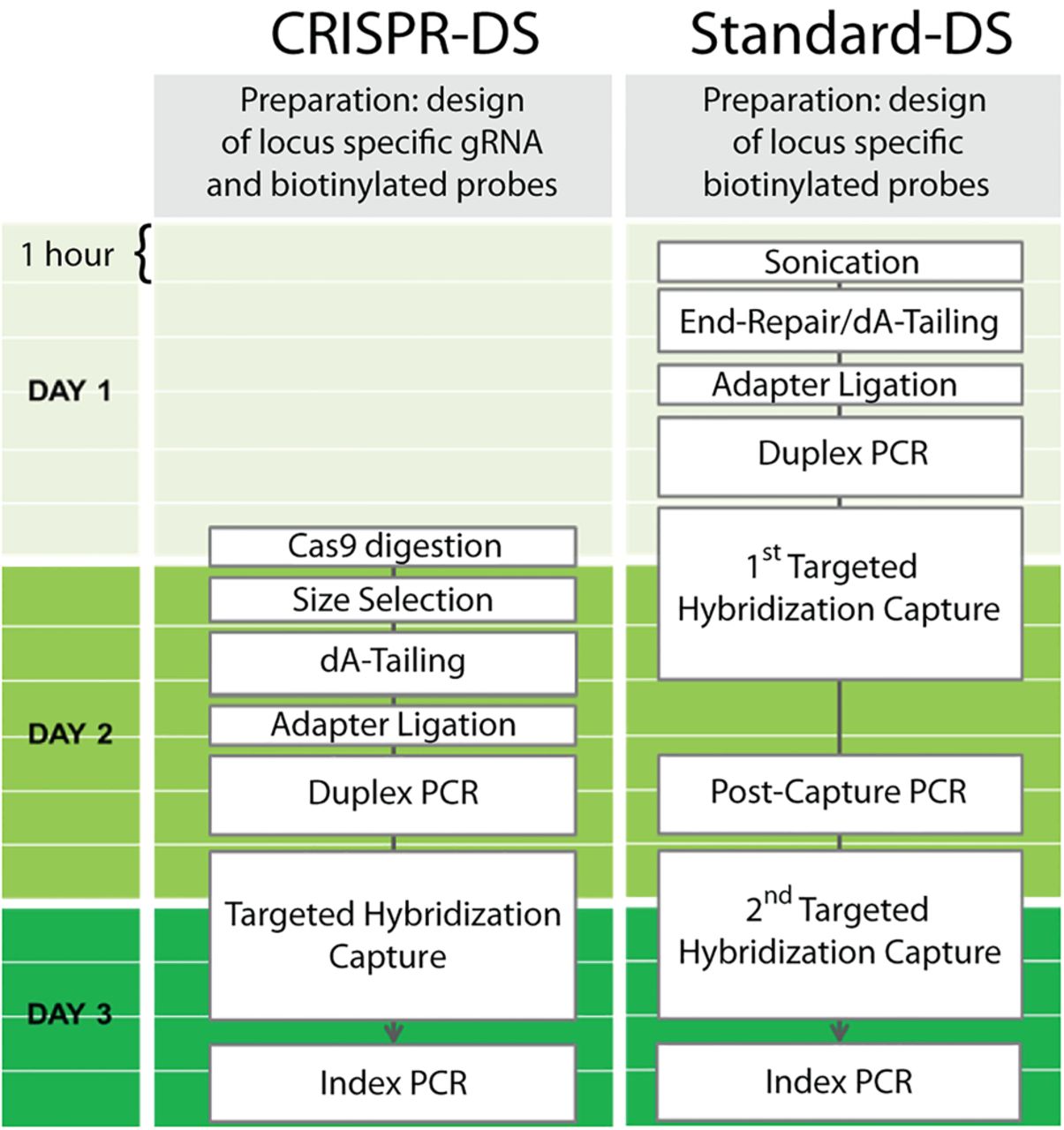
Comparison of library preparation protocols for standard-DS versus CRISPR-DS. The primary differences between the CRISPR-DS and standard-DS library preparation are the fragmentation methods and the number of hybridization capture steps. Instead of fragmentation by sonication as performed in standard-DS, CRISPR-DS relies on an in vitro excision of target regions by CRISPR/Cas9 followed by size selection for the excised fragments. Although this method requires additional preparation to design locus-specific gRNAs, this is a one-step process that then reduces the protocol by nearly a day. The reduction is achieved by the elimination of the second round of hybridization capture, which is required for sufficient target enrichment in the standard-DS protocol but not in CRISPR-DS. Colored boxes represent 1 h of time.



