


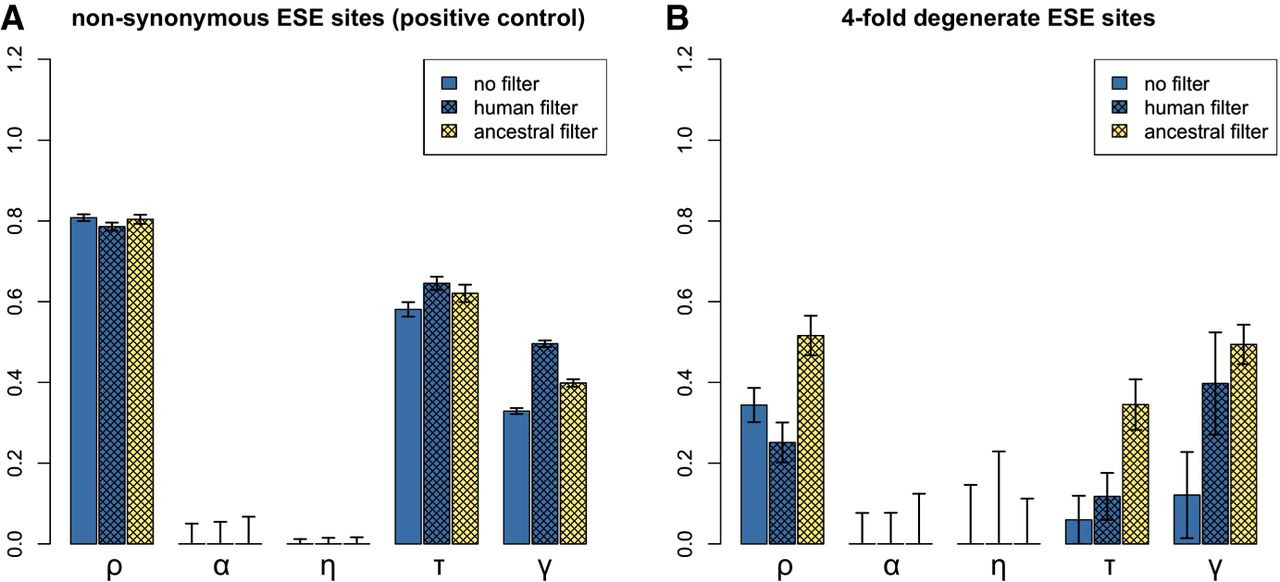
INSIGHT estimates for nonsynonymous (A) and for fourfold degenerate (B) ESE sites. (ρ) Fraction of sites under selection; (α) fraction of divergences driven to fixation by positive selection; (η) scaling factor on the divergence rate at selected sites; (τ) fraction of polymorphisms under weak negative selection; (γ) scaling factor on the site frequency spectrum at selected sites. Human CpG-filtering is expected to be more reliable for ρ, τ, and γ; ancestral CpG-filtering is expected to perform better for α and η. For the positive control (A), INSIGHT detects significant evidence for negative selection, including weak negative selection. At fourfold degenerate ESE sites, INSIGHT reports negative selection, which is likely mostly strong, as there is little to no significant evidence for weak negative selection with the more reliable human CpG-filtering method.



