


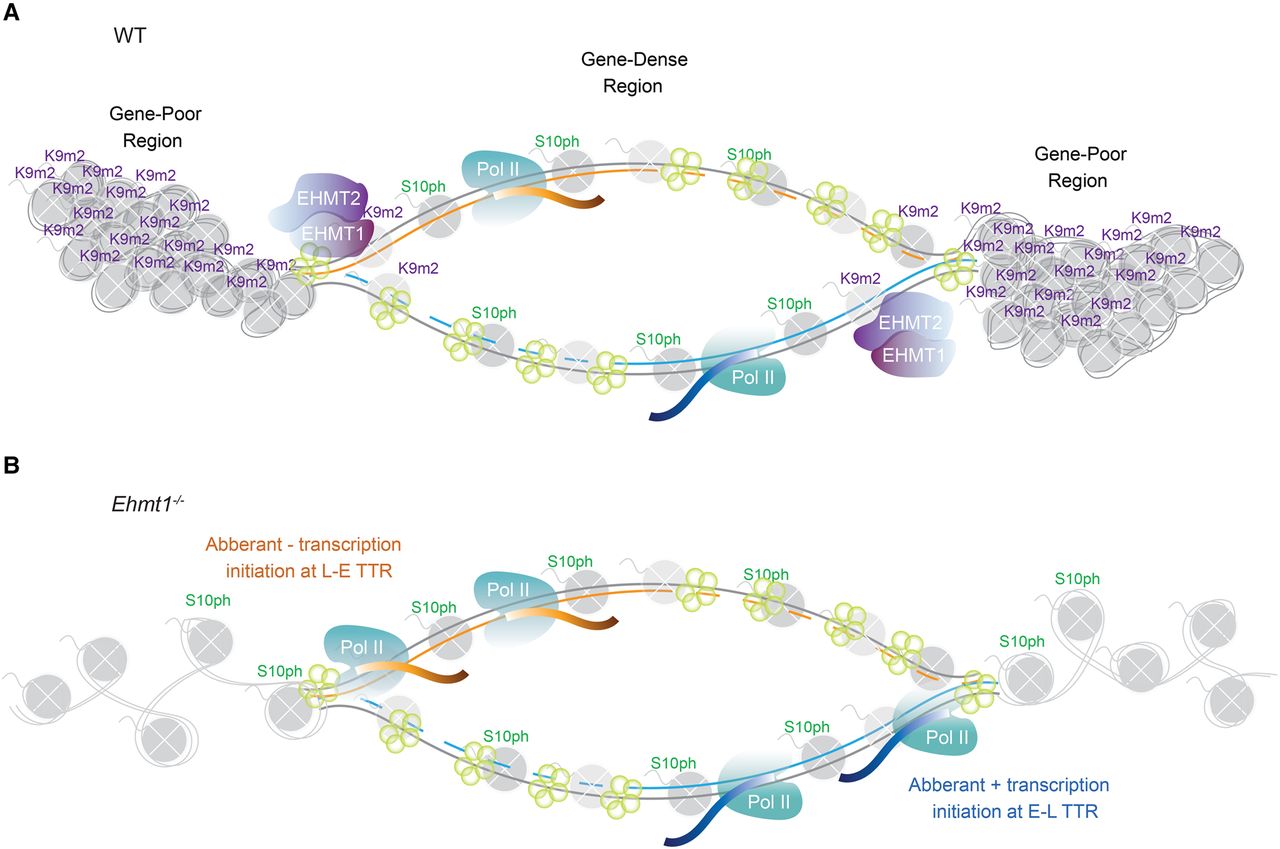
Model of the interplay between H3S10ph and H3K9me2 during DNA synthesis in ESCs and the influence of perturbing H3K9me2 deposition on strand-biased transcription. (A) Schematic of a hypothetical replicon in WT ESCs, with AURKB-independent H3S10ph marking early-replicating, gene-dense regions and EHMT2/EHMT1-dependent H3K9me2 marking late-replicating, gene-poor regions. Replication timing transition regions, present at the edges of the replicon, coincide with the interface of H3S10ph and H3K9me2 domains in WT ESCs. In the interest of clarity, a single replication fork encompassing the entire replicon is depicted; multiple adjacent replicons may coexist within TTRs (Petryk et al. 2016). (B) Schematic of the same replicon in Ehmt1−/− ESCs showing that, in the absence of H3K9me2, H3S10ph spreads into late-replicating regions, coincident with aberrant transcription initiating asymmetrically at TTRs; showing a plus-strand bias at early-to-late (E to L) and a minus-strand bias at late-to-early (L to E) TTRs. Thus, in both cases, transcription is co-oriented with leading strand synthesis.



