


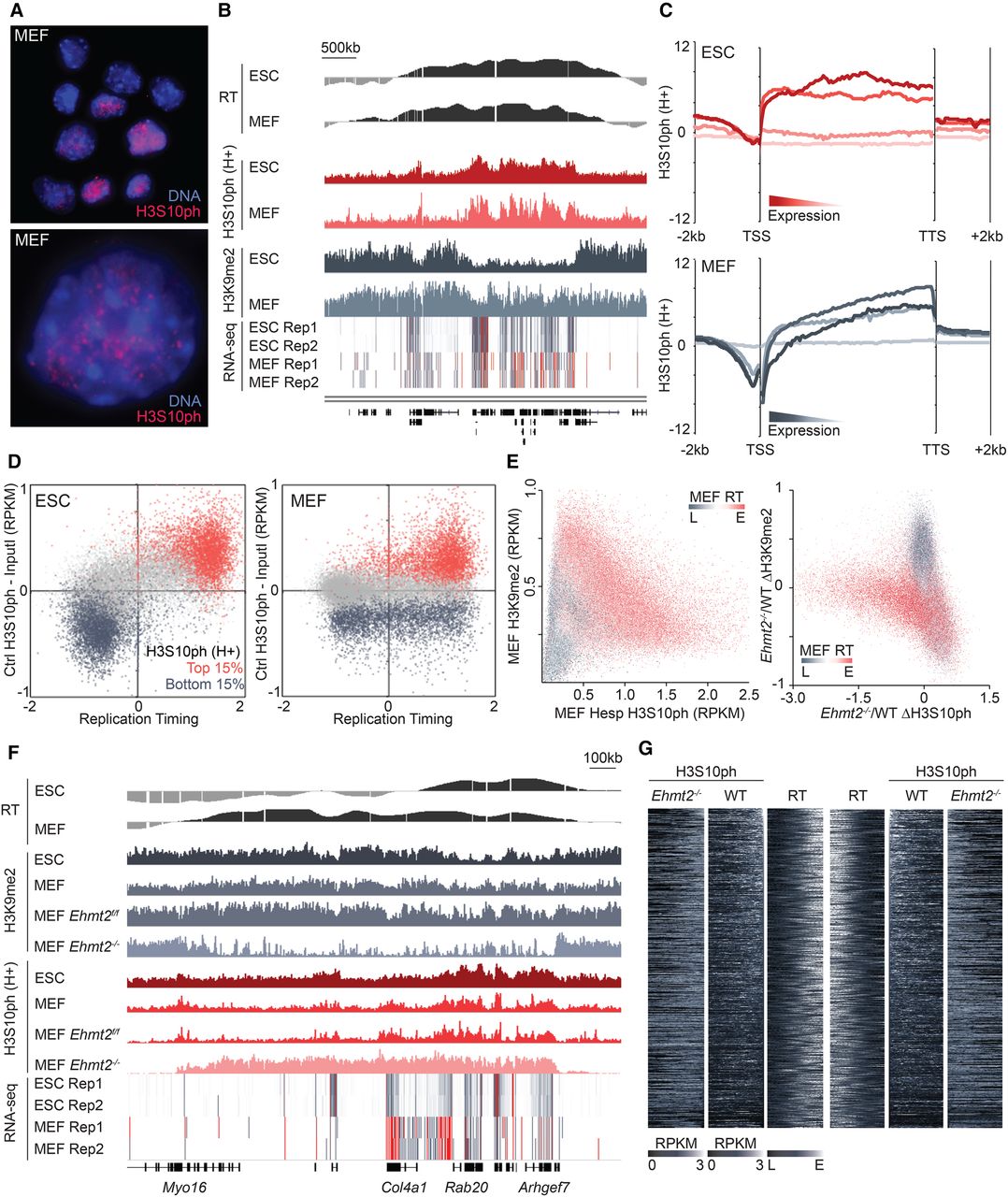
H3S10ph is restricted to genic regions in interphase MEFs. (A) H3S10ph immunostaining of interphase WT MEFs, counterstained with Hoechst 33342 for DNA, as in Figure 1A. (B) Genome browser screenshot showing RT, H3K9me2, and biological replicates of RNA-seq coverage in ESCs and MEFs as well as H3S10ph in Hesp-treated cells. (C) Metagene analysis of normalized H3S10ph enrichment (input subtracted RPKM) over all murine gene bodies (−2 kb-TSS-TTS+2 kb), clustered by RNA-seq expression levels into quartiles in the respective cell type. (D) Pair-wise comparison of H3S10ph with replication timing in asynchronous ESCs and MEFs using genome-wide 10-kb tiling bins. Red and blue data points correspond to bins that were in the top and bottom 15% of H3S10ph enrichment, respectively, in Hesp-treated cells. (E) Pair-wise comparison of H3S10ph (Hesp-treated) with H3K9me2 genome-wide (5-kb bins) in WT and Ehmt2−/− MEFs, overlaid with a heat map of MEF RT data with red and gray data points representing early- and late-replicating bins, respectively. (F) Genome browser snapshot of a MEF-specific early-replicon showing the loss of intergenic H3K9me2 and concurrent gain of H3S10ph in Ehmt2−/− MEFs. (G) Heat map of H3S10ph enrichment in Hesp-treated WT and Ehmt2−/− MEFs over 500 kb, centered on all RT transition boundaries in WT MEFs.



