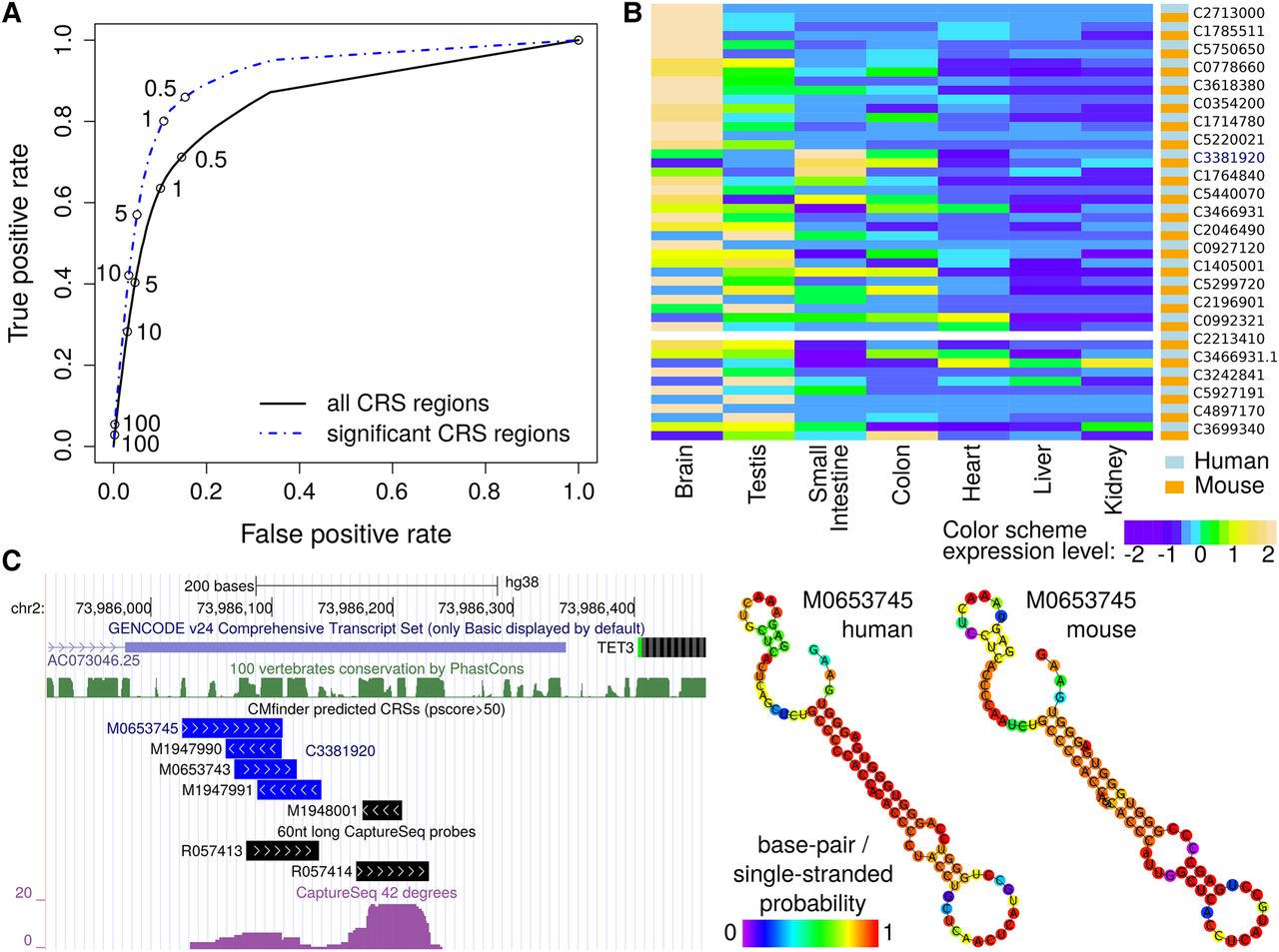
CaptureSeq and qRT-PCR show conserved expression of CRSs. (A) ROC curve of CRS region detection in brain based on public poly(A) RNA-seq defined by different CPM/RLE cutoffs (numbers on the curves) using the CRS region detection through CaptureSeq in fetal brain as the gold standard. (B) Expression profiles of 23 CRS regions were measured with qRT-PCR (normalized by CRS regions) in seven tissues in both human and mouse. The CRS regions have weakly conserved primary sequences and were expressed in the CaptureSeq (P < 0.1). The CRS regions are sorted by decreasing Pearson's correlation coefficients of expression profiles between human and mouse. (C) The CRS region C3381920 is located in the 3′ end of the lncRNA AC07304.25. Despite no expression in brain in publicly available total and poly(A) RNA-seq data, it showed up in human brain in both CaptureSeq and qRT-PCR. Common expression in human and mouse was observed in the gastrointestinal tract (small intestine and colon; see B). Region C3381920 contains the CRS M0653745 whose structure is highly conserved between human and mouse. Color code in human and mouse structures is base-pair probabilities calculated by the Vienna RNA package (Lorenz et al. 2011).