


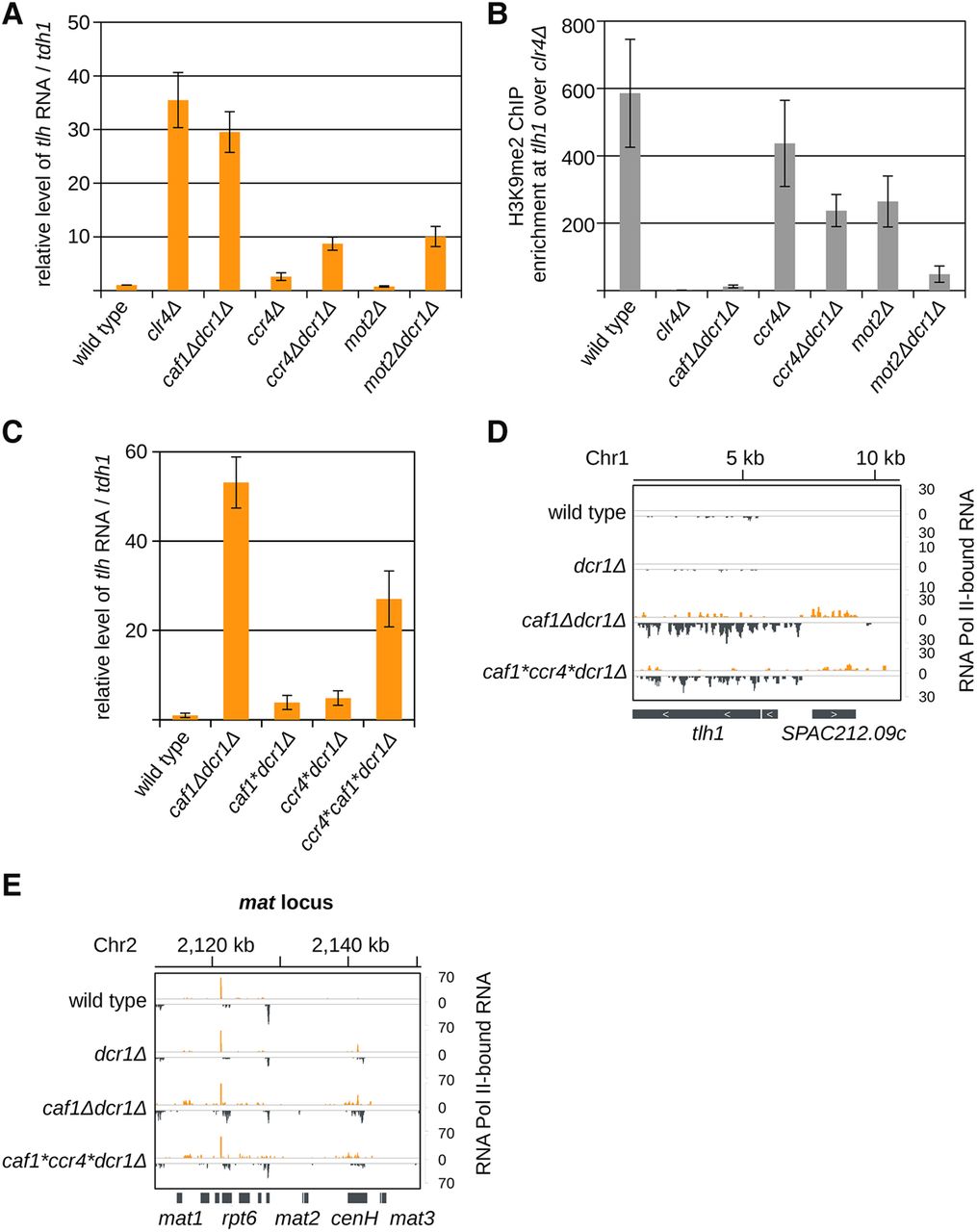
Caf1 and Ccr4 nuclease activity is required for heterochromatic silencing. (A) Quantification of subtelomeric tlh transcripts in indicated strains by RT-qPCR. In ccr4Δdcr1Δ and mot2Δdcr1Δ cells, silencing of subtelomeric repeats is defective, but not as much as in caf1Δdcr1Δ or clr4Δ cells. Error bars, SE of three or more independent experiments. Reverse transcription was performed with specific primers; the wild type was set to one. (B) ChIP experiment showing that H3K9me2 is lost at subtelomeric tlh repeats in mot2Δdcr1Δ cells but not in ccr4Δdcr1Δ. Error bars, SE of two (mot2Δ and mot2Δdcr1Δ) or more independent experiments. clr4Δ was set to one. (C) Quantification of subtelomeric tlh transcripts by RT-qPCR in the wild type or caf1Δdcr1Δ controls or in dcr1Δ strains expressing a Caf1* (Caf1D53AD243AD174A) or/and a Ccr4* (Ccr4H665A) activity mutant. Expression of Caf1* or Ccr4* silences tlh, but when both deadenylases are mutated, silencing of tlh is lost. Error bars, SE of three independent experiments. Reverse transcription was performed with specific primers; the wild type was set to one. (D,E) Sequencing reads of RNA Polymerase II (Pol II)–associated RNA in indicated cells are plotted over the subtelomeric tlh region (D) and over the mat locus (E). In caf1*ccr4*dcrΔ cells, transcription at etlh and SPAC212.09c and at the mat locus is increased compared with wild-type cells. Reads from + and − strands are depicted in orange and gray, respectively. Scale bars on the right denote RNA read numbers normalized to the total number of reads mapping to protein coding genes.



