


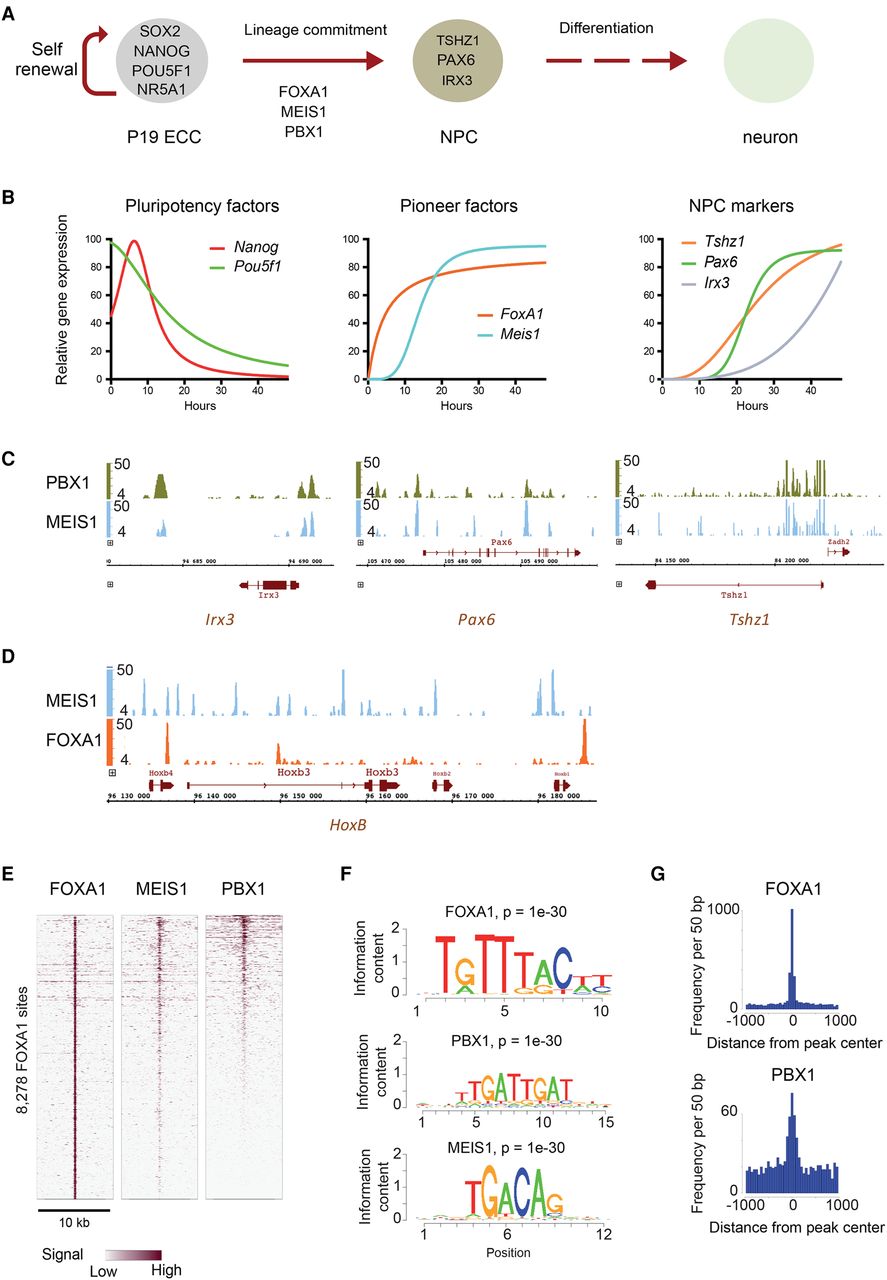
Pioneer factors and NPC differentiation. (A) Pluripotent P19 EC cells derive from a 6.5-dpc mouse embryo and can differentiate into neural progenitor cells (NPCs) when treated with retinoic acid (RA). Pluripotency factors expressed in these cells include POU5F1, NANOG, SOX2, and NR5A1. Under the influence of RA, FOXA1, MEIS1, and PBX1 are induced and control the commitment of P19 EC cells to NPCs which express marker genes like Tshz1, Pax6, and Irx3. (B) RT-qPCR analysis of marker gene expression during 48 h of NPC differentiation after addition of RA. Curves were fitted with the GraphPad Prism software. (C) NPC marker genes are direct targets of TALE-HDs. Integrated Genome Browser (IGB) screenshots showing MEIS1 and PBX1 ChIP-seq signals at Irx3, Pax6, and Tshz1 loci in RA-treated cells. (D) IGB screenshot of FOXA1 and MEIS1 ChIP-seq signals from NPCs at the HoxB cluster, showing that FOXA1 and MEIS1 share common binding sites. (E) Heat maps showing FOXA1, MEIS1, and PBX1 ChIP-seq signals at 8278 FOXA1 sites in P19 cell-derived NPCs. (F) Logos of motifs enriched at FOXA1 binding sites. (G) Distribution of FOXA1 and PBX1 motifs in 50-bp windows centered on FOXA1 binding sites.


