


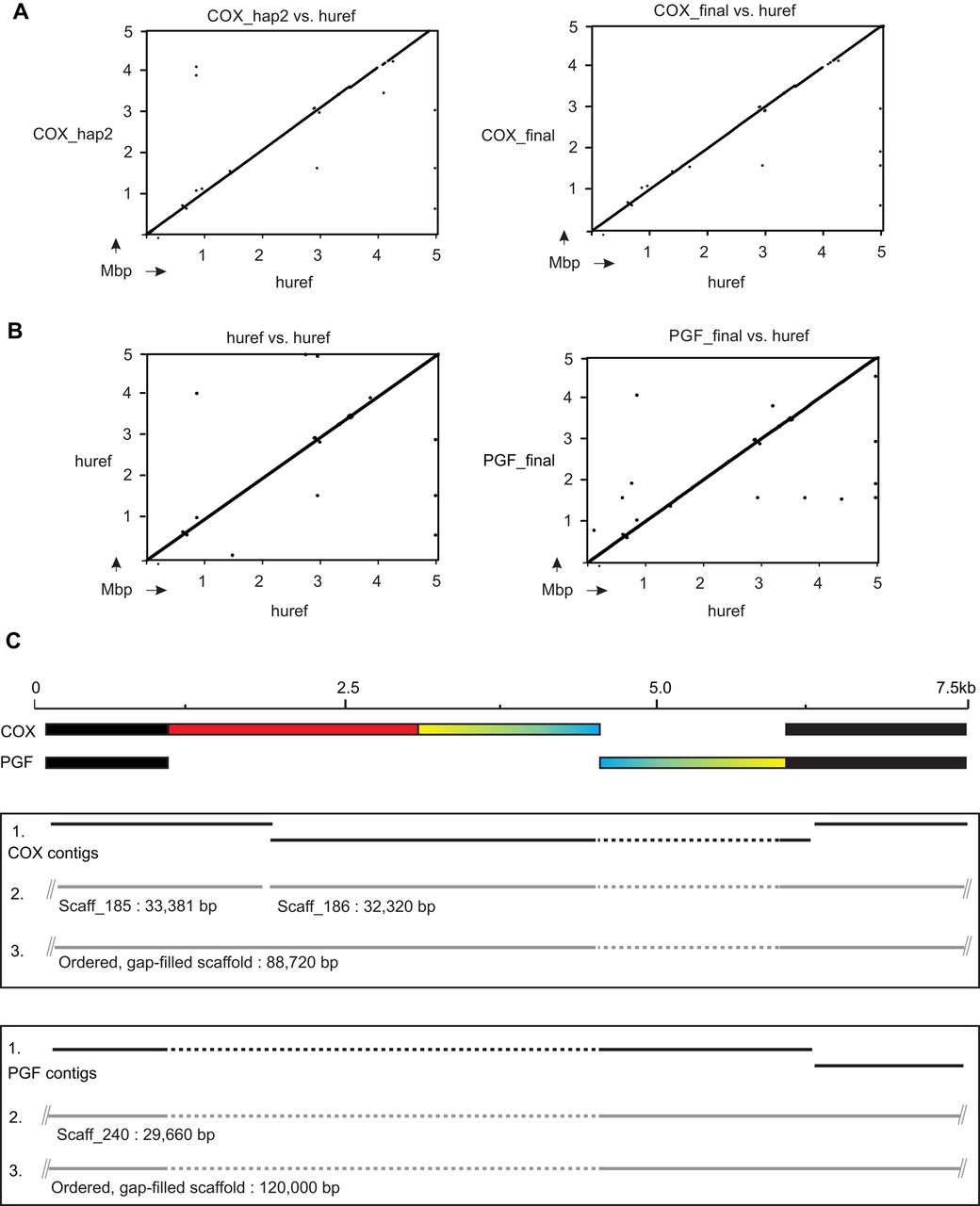
In silico reference-guided scaffold orientation correctly assembles complex structural variation. (A) Results obtained from dot plot comparisons of the original COX haplotype (hap_2: left) and our newly-sequenced and assembled COX haplotype (right) against the human reference MHC region sequence (huref). This shows the haplotypes were assembled in the correct order. (B) The human reference MHC region sequence (huref) was derived from the PGF cell line. Here, the PGF haplotype was assembled using a modified COX haplotype sequence as a guide to orient the scaffolds obtained from the PGF sequence data. Because PGF had been sequenced previously, we were able to compare dot plots of the original sequence against itself (left) with plots of our newly sequenced and assembled version against the original (right). Identical results were obtained. (C) Complex structural variation observed from comparison of the COX and PGF haplotypes. The colored segment from COX is inverted (blue/yellow) and partially deleted (red) in PGF. The assembly process for COX (upper box) and PGF (lower box) is denoted from the top down in each case. (1) Shows the de novo generated contigs, (2) shows the scaffolds that were built from the contigs, and (3) shows the final sequence scaffolds generated.



