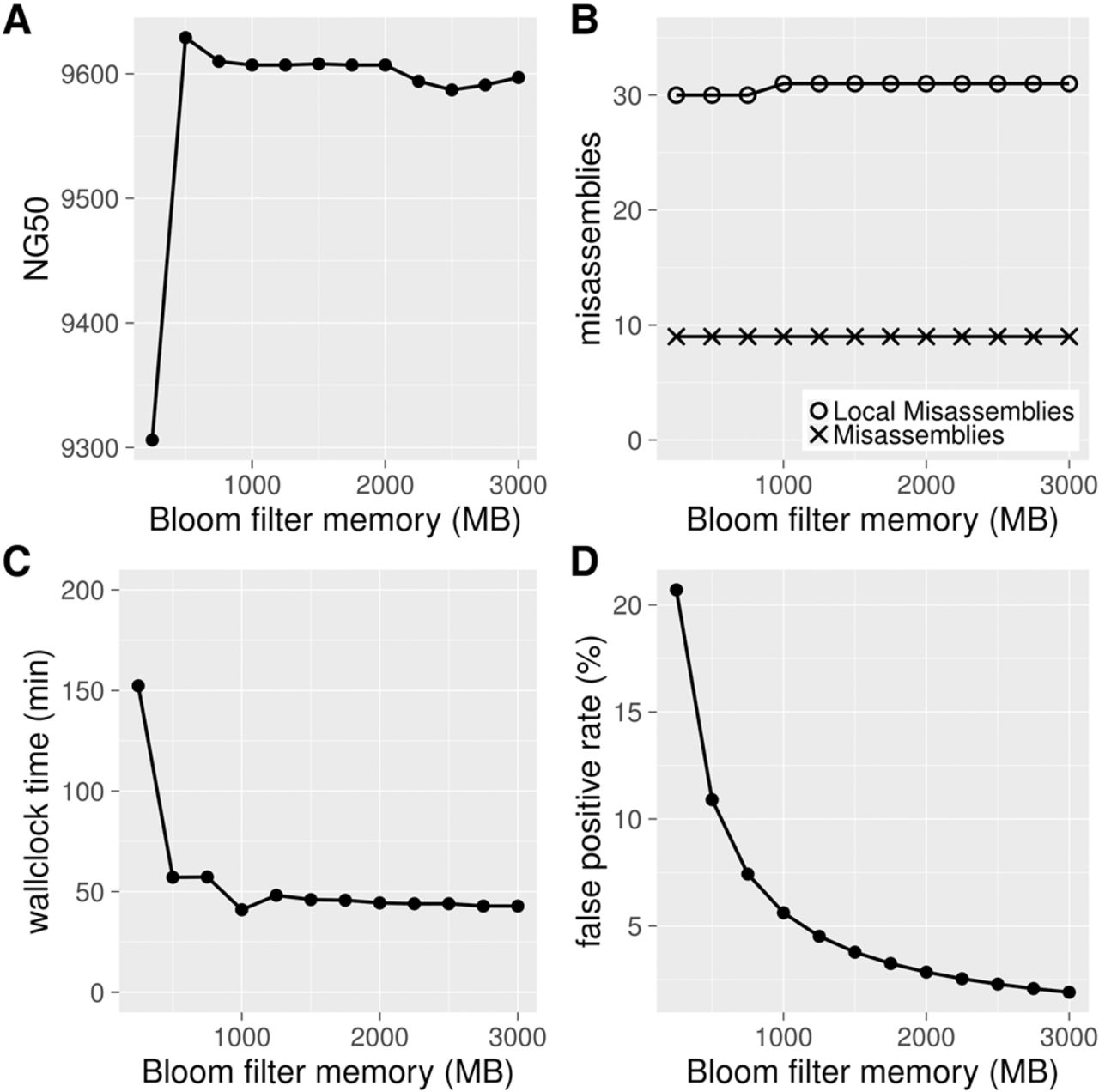
Effect of Bloom filter memory allocation on ABySS 2.0 assemblies of the C. elegans DRR008444 data set. (A) The assembly contiguity (NG50) remains stable in the neighborhood of 9600 bp as the Bloom filter allocation decreases from 3000 MB of 500 MB but drops sharply as the allocation is further decreased from 500 to 250 MB. (B) The number of major misassemblies (9) and local misassemblies (30–31) reported by QUAST remains stable as the Bloom filter allocation is decreased from 3000 to 250 MB. (C) The assembly wall-clock time increases gradually as the Bloom filter allocation is decreased from 3000 to 500 MB but rises sharply from 57 to 152 min when the allocation is further decreased from 500 to 250 MB. (D) The relationship between Bloom filter false-positive rate and the Bloom filter memory allocation. From these results, we conclude that a Bloom filter FPR in the range of 5%–10% provides a good balance between assembly time and memory usage, without any detrimental effect on assembly quality.