


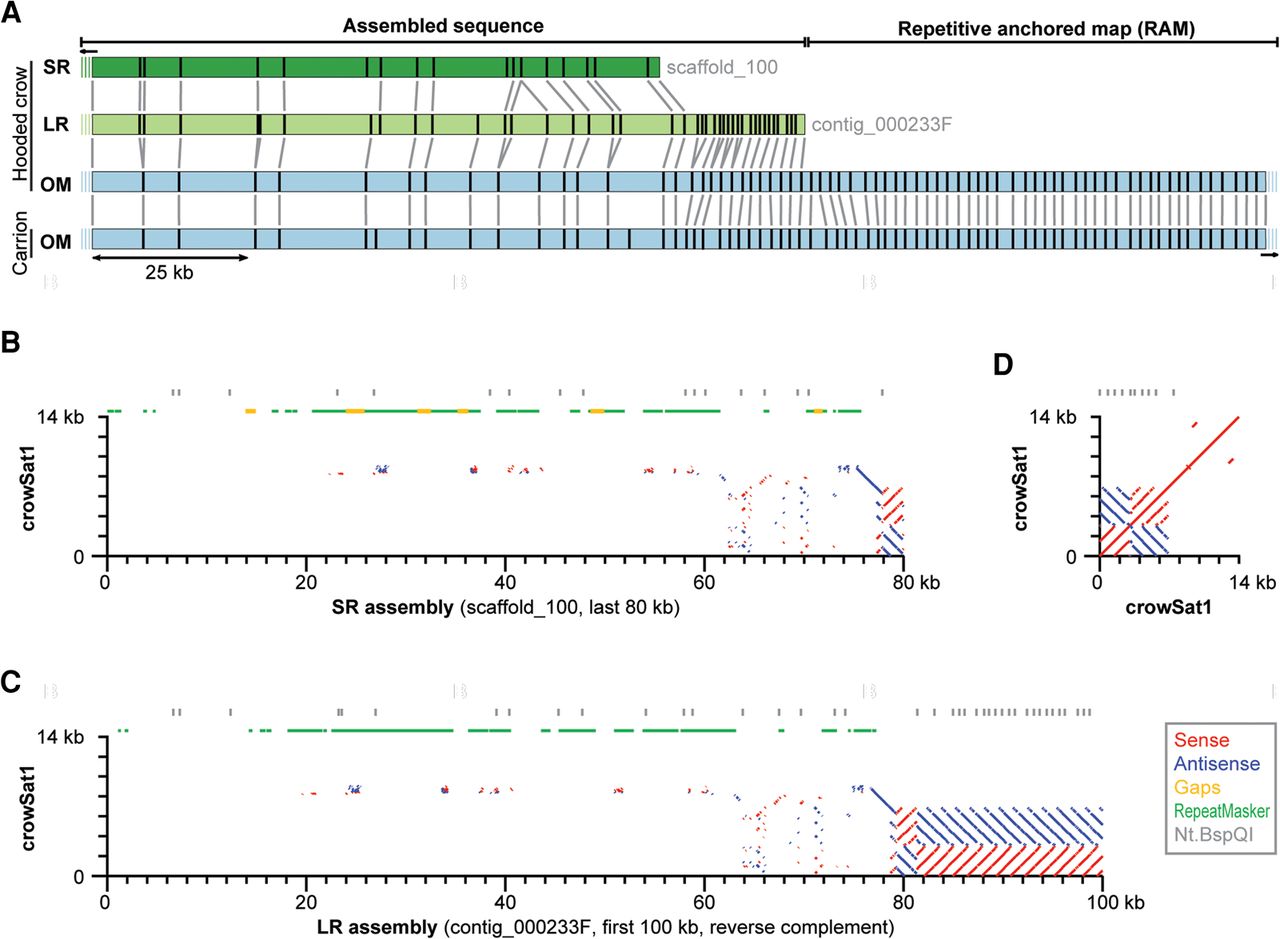
Identification of putatively heterochromatic tandem repeat arrays. (A) Shown are the alignments of independent OM assemblies from a carrion and hooded crow individual (light blue) to the SR (dark green) and LR (light green) of the same hooded crow individual. Vertical bars in boxes correspond to nickase motifs of the enzyme Nt.BspQI, and gray vertical bars between boxes indicate orthologous nicks. The nickase motif pattern in both OM contigs matched the end of the SR scaffold or LR contig, and the part beyond is characterized by dense occurrence of nickase motifs every ∼3 kb, indicating a tandem repeat array. We termed such OM contigs “repetitive anchored maps” (RAMs). (B,C) Sequence similarity plots of the 14-kb crowSat1 consensus sequence aligned against assembled contigs/scaffolds of the SR (B) and LR (C) assembly (the same region as shown in A), and self-alignment of the crowSat1 consensus sequence (D). The latter suggests that crowSat1 is an >14-kb tandem repeat with an internal palindrome (blue) of tandemly repeated subunits (red). The most contiguous assembly of crowSat1 units is at the end of contig_000233F of the LR assembly (C) (but see also contig_000396 which entirely consists of crowSat1) (Supplemental Fig. S4), containing the palindrome and 13 tandem repeat units. This region is orthologous to the end of scaffold_100 of the SR assembly, where it exhibits fewer assembled crowSat1 units (B). Note that the flank of the crowSat1-bearing RAM is highly enriched for RepeatMasker-annotated repeats (green; mostly TEs) and many short remnants of crowSat1 (red and blue dots).



