


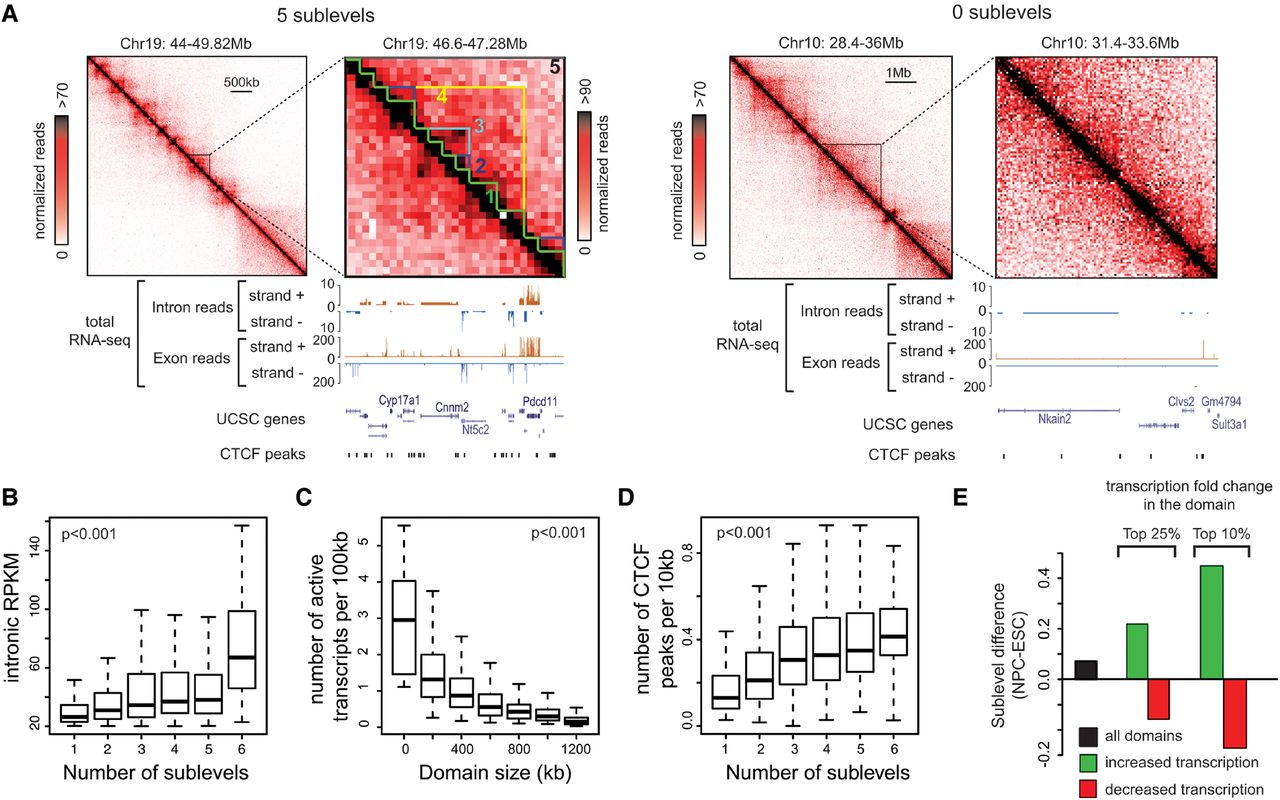
Local (changes in) folding complexity correlate with transcriptional activity in ESCs and during differentiation. (A) Examples of regions with different levels of local folding complexity and correlated transcriptional activities. (B) The number of sublevels in a domain correlates with the transcriptional activity within the domain (shown for domains at 65% RI in ESC). P-value: Student's t-test associated to Spearman's correlation coefficient. (C) Smaller domains tend to be denser in actively transcribed genes and therefore globally more active than larger domains (shown for domains at 65% RI). (D) The number of sublevels in a domain correlates with the density of CTCF-bound sites within the domain (shown for domains at 65% RI). (E) Local changes in transcriptional activities during differentiation from ESCs to NPCs correspond to changes in local hierarchical complexity (see Methods). Differences in the number of hierarchical sublevels are shown for the 25% and 10% most up- or down-regulated domains identified at 65% RI in ESC.



