


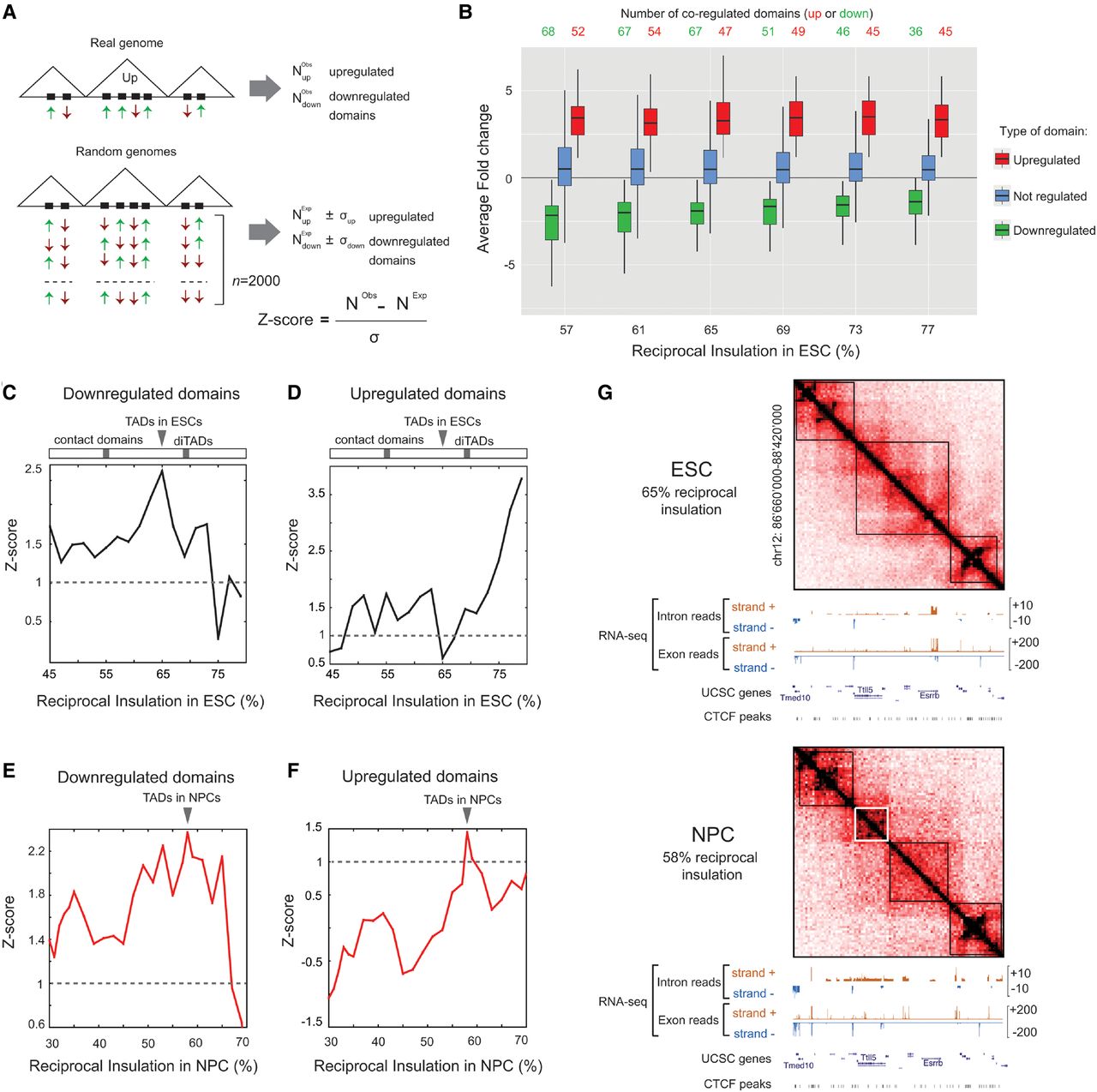
Transcriptional coregulation defines a functional privileged scale. (A) Schematic representation of the definition of statistical enrichment in the number of coregulated domains. A domain is down- (up-) coregulated if its number of down- (up-) coregulated genes is larger than in 95% of cyclic permutated genomes (empirical P ≤ 0.05). A Z-score is calculated as the difference between the number of coregulated domains detected in the real genome (Nobs) and the mean number of coregulated domains detected in 2000 randomized genomes (Nexp), weighted by its standard deviation σexp. (B) Distribution of average fold changes in expression level for domains at different RI values. For each RI value, the number of domains that are either up- or down-regulated during differentiation (at the P ≤ 0.05 level) is also shown in the upper part of the graph. Box: 25%–75% range (black line: median). (C) The statistical enrichment in the number of down-regulated domains is plotted as a function of the RI threshold. Transcriptional coregulation is significant at any level below ∼70% RI but maximal at 65%. (D) Same as panel C for up-regulated domains. (E) Same analysis as in panel C when using domains based on Hi-C data in NPCs. (F) Same as panel E for up-regulated domains. (G) Example of domains that were created de novo during differentiation and detected only in the set of NPC TADs (58% RI).



