


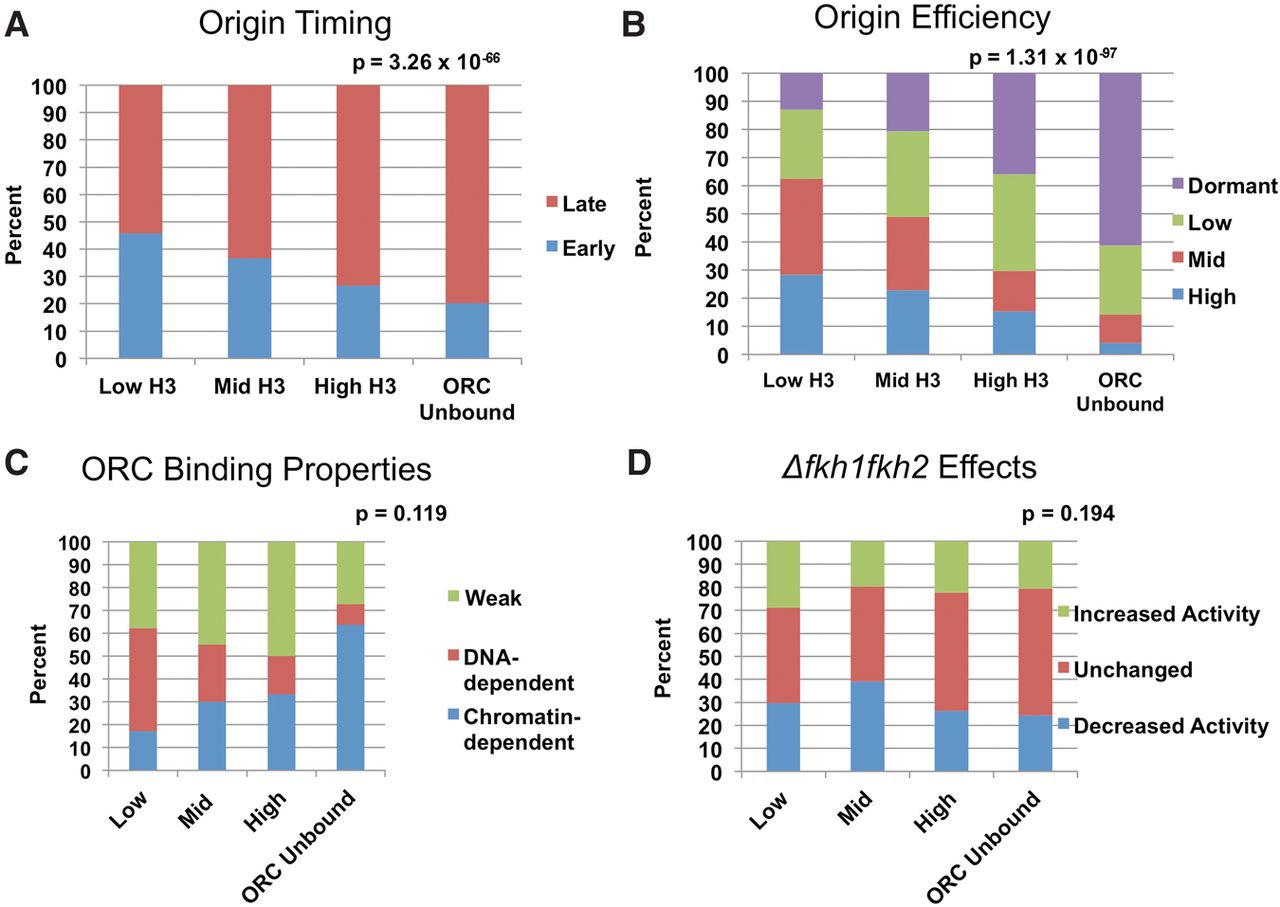
Nucleosome occupancy in G1 correlates with origin properties. (A) All origins classified by nucleosome occupancy (n = 393) were correlated with origin timing (late or early firing), which was defined by origin usage in the presence of HU (Belsky et al. 2015). (B) Correlation of nucleosome occupancy with origin efficiency. Previously established values for origin efficiency metric (McGuffee et al. 2013) were used to classify origins as high (blue), mid (red), low (green), or dormant (purple) efficiency (Methods). (C) Nucleosome occupancy correlated with ORC binding properties for 66 origins, which were previously classified as DNA-dependent (red), chromatin-dependent (blue), or weak (green) (Hoggard et al. 2013). (D) Nucleosome occupancy correlated with origins where activation depended on Forkhead proteins (Knott et al. 2012). Origins that decrease (blue), increase (green), or are unchanged (red) in activity in the fkh1fkh2 mutant are shown.



