


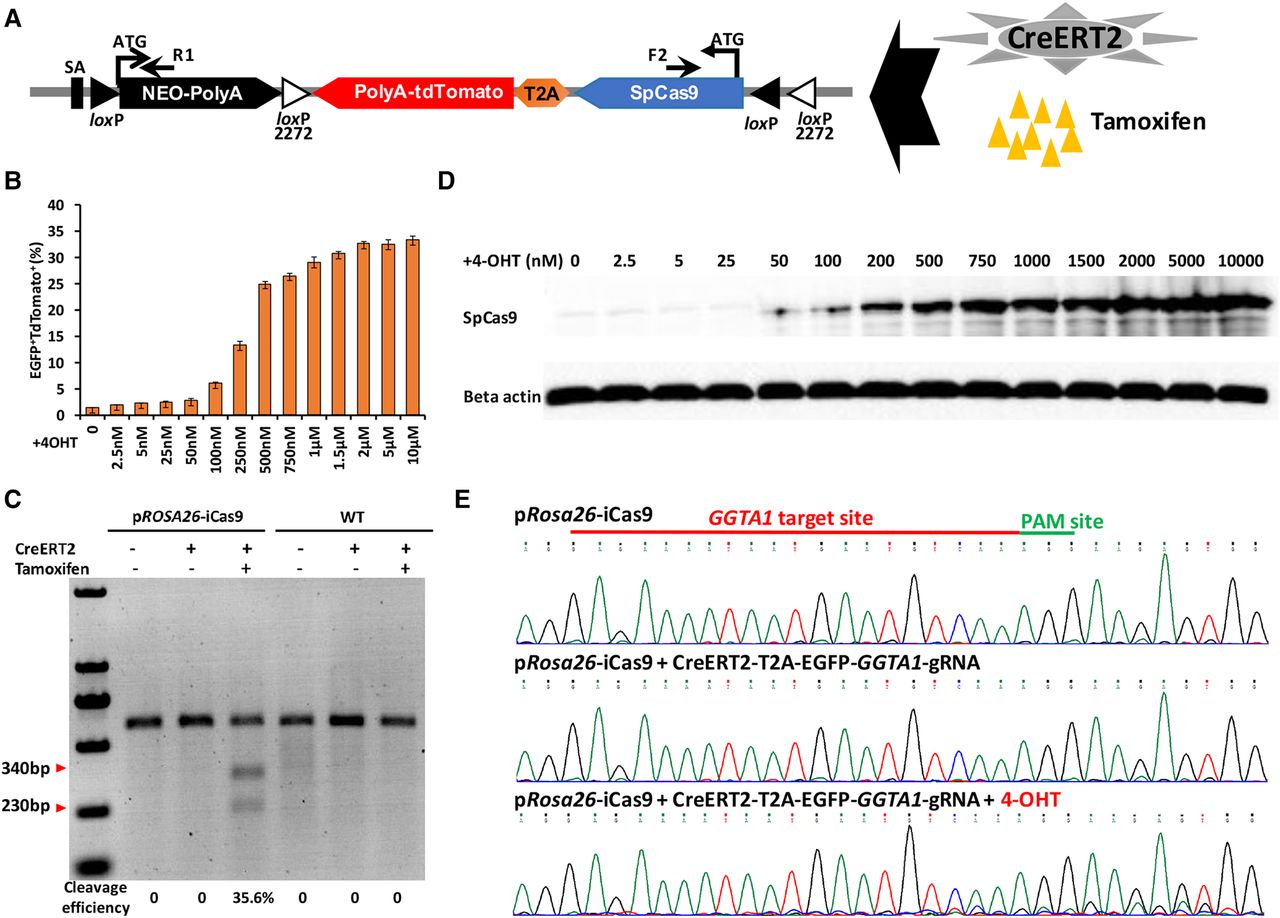
Establishment and characterization of 4-OHT-inducible system in pRosa26-iCas9 fibroblasts. (A) Schematic of 4-OHT-induced SpCas9 and tdTomato expression in pRosa26-iCas9 fibroblasts infected with lentivirus containing CreERT2. (B) Percentage of EGFP- and tdTomato-positive cells under different concentrations of 4-OHT (0–10 µM). (C) Western blot analysis for verifying SpCas9 expression with different concentrations of 4-OHT inductions. (D) T7EN1 assays showing indel formation at the GGTA1 locus in pRosa26-iCas9 infected with lentivirus containing CreERT2, EGFP, and GGTA1-sgRNA and simultaneously supplied with 4-OHT, while not in uninfected or untreated fibroblasts. (E) Sanger sequencing analysis of the GGTA1-sgRNA targeting site. Top: pRosa26-iCas9 fibroblasts; middle, pRosa26-iCas9 fibroblasts infected with lentivirus containing CreERT2 and GGTA1-sgRNA, but not supplied with 4-OHT; bottom, pRosa26-iCas9 fibroblasts infected with lentivirus containing CreERT2 and GGTA1-sgRNA, simultaneously supplied with 4-OHT.



