


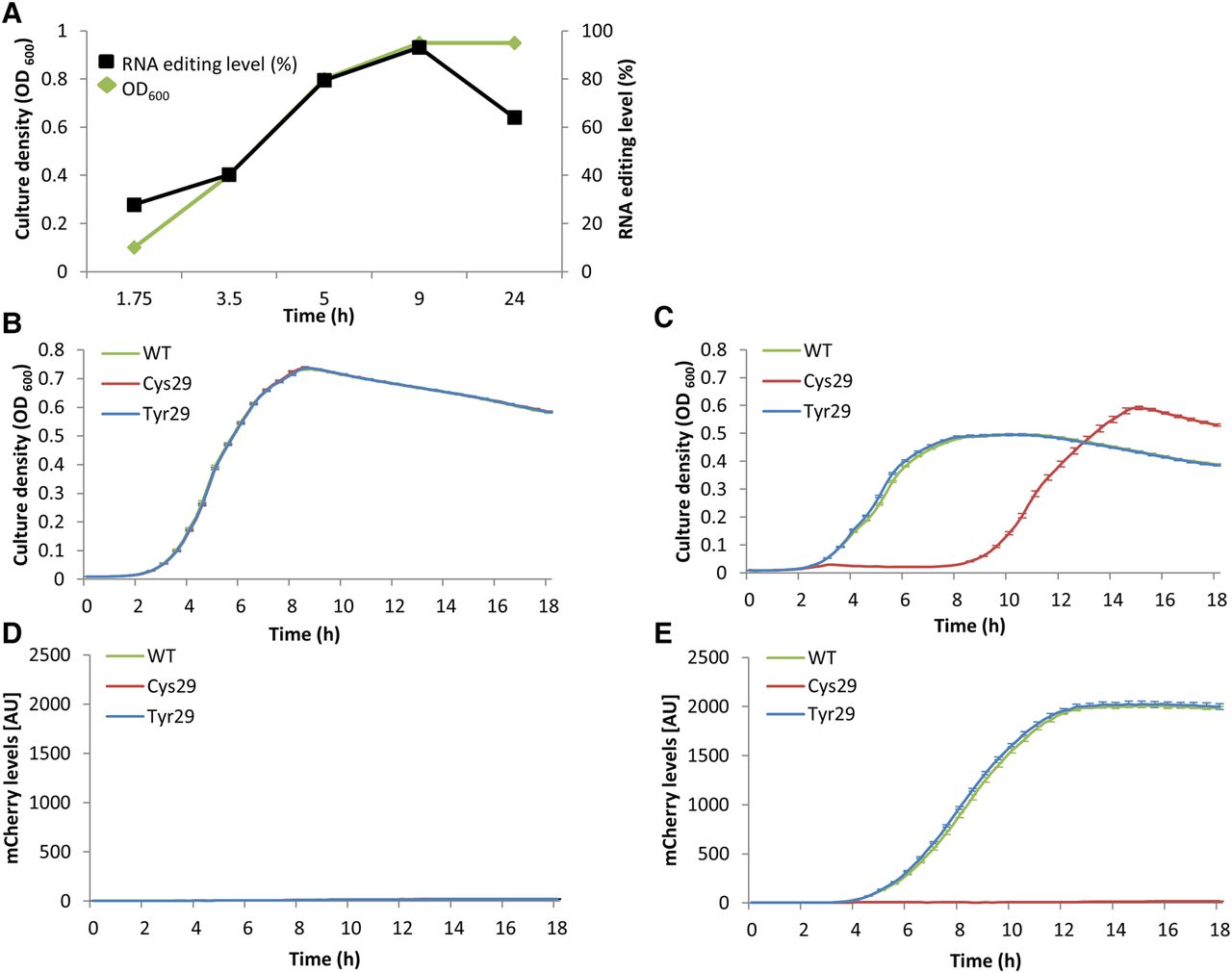
hokB mRNA editing increases with cell density and enhances its toxicity. (A) hokB mRNA editing levels (black) in E. coli MG1655-EcM2.1 WT strain as measured in different culture densities (green). Notably, the standard error of measuring editing levels in a given coverage in all samples was smaller than 0.00012%. (B–E) The E. coli Top10-ΔhokB strain was transformed with inducible plasmids harboring the WT (green), constitutively edited (Cys29, red), and noneditable (Tyr29, blue) hokB versions fused to mCherry reporter protein (N-terminus). (B) Growth analysis without induction of hokB (0% arabinose). (C) Growth analysis with induction of hokB (0.2% arabinose). (D) mCherry levels without induction (0% arabinose). (E) mCherry levels with induction (0.2% arabinose). Error bars represent standard error for 14 replicates (B–E).



