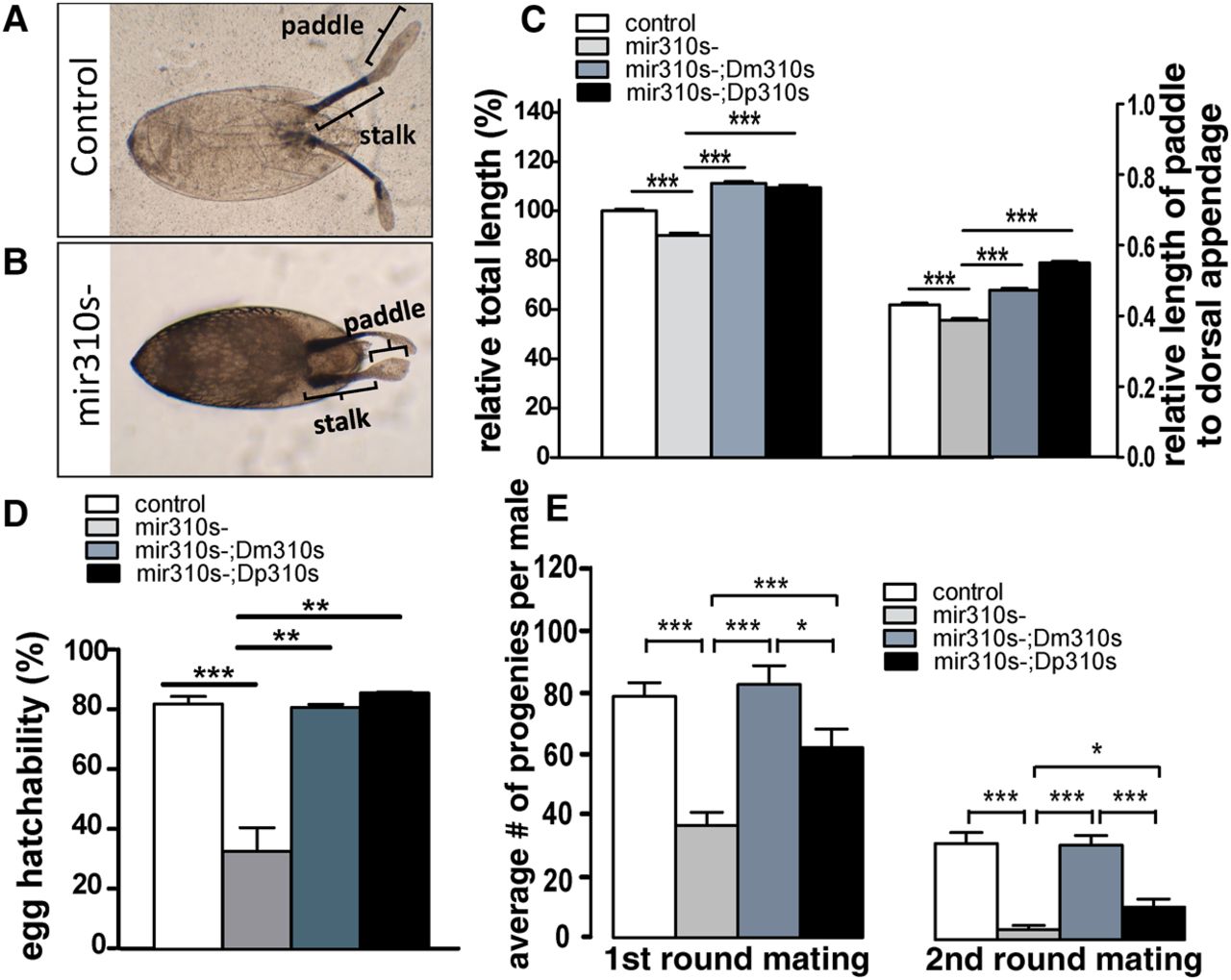
Three phenotypic defects in the mir310s- flies rescued by Dm310s or Dp310s. The reintroduced mir310s of either D. melanogaster (Dm310s) or D. pseudoobscura (Dp310s) are used. (A,B) The dorsal appendage of eggshell consists of a stalk and a paddle. Note that the paddle of the mir310s- egg is flattened and shortened. (C) Loss of miR310s significantly shortened the dorsal appendage (left), especially the paddle (right). Either Dm310s or Dp310s rescued the phenotypes (more than 200 eggs examined for each genotype). (D) Loss of miR310s significantly decreased egg hatchability, which could also be fully rescued by Dm310s or Dp310s. (Five replicates, each with more than 100 eggs for each genotype.) (E) Average number of progeny produced by each male in two consecutive matings. Mean progeny count of mir310s- males was reduced by >50% in the first round of mating and 87% in the second round. Dm310s fully restored the fertility, but Dp310s rescue is partial. More than 15 males were individually tested for each genotype; error bars, SEs. (*) P < 0.05, (**) P < 0.01, (***) P < 0.001 by Student's t-test.