


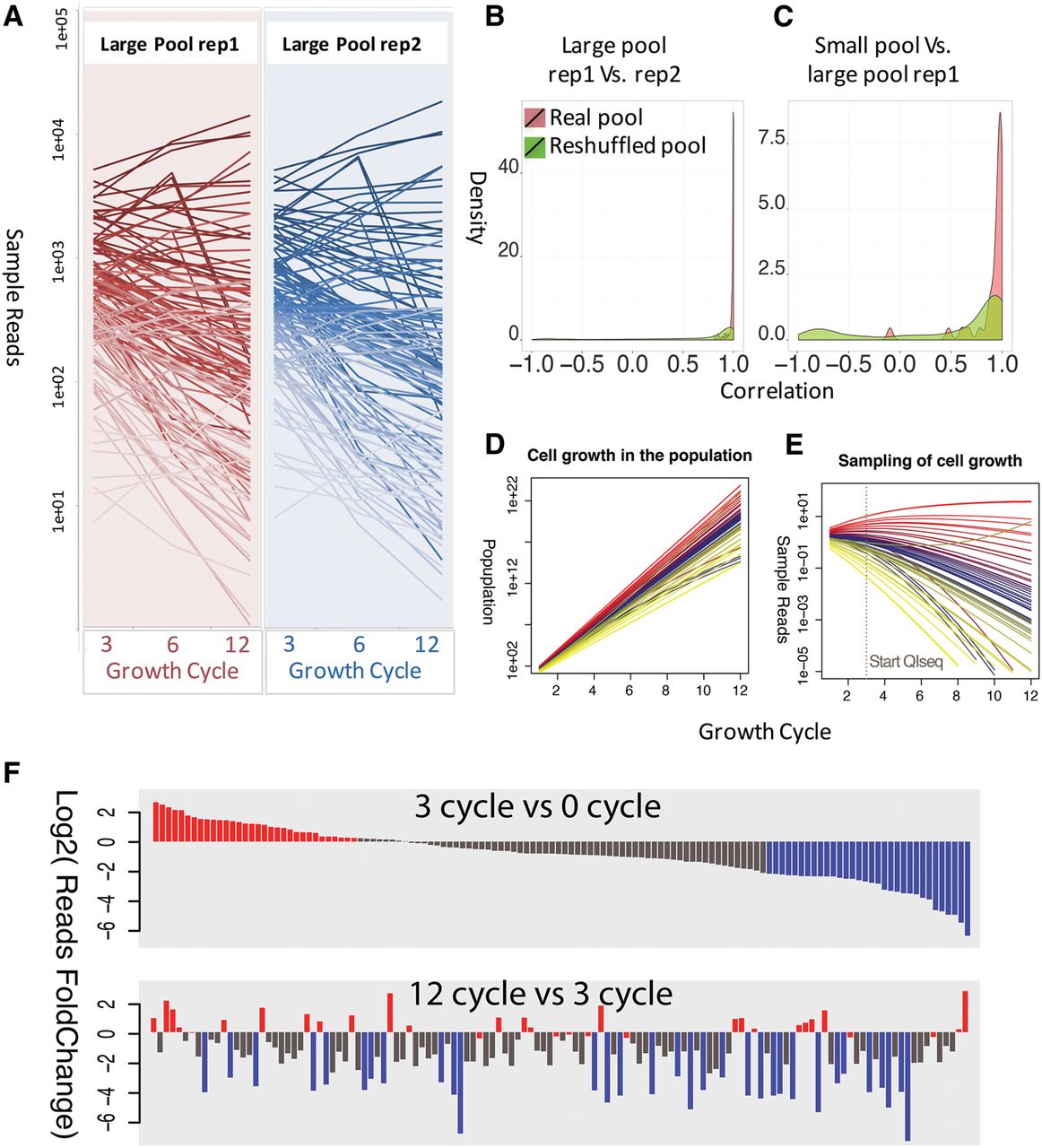
Using QIseq to measure growth of 128 piggyBac mutants in a single pool. (A) Growth of each mutant within two biological replicates (rep1, rep2) of the same pool, grown over 12 cycles. (B) Permutation-based statistical test of reproducibility between replicates and between different screens. (C) The same mutants in different replications always had a significantly higher correlation compared with randomly reshuffled mutant pairs (Wilcoxon test P < 1 × 10⁻⁵). (D) Estimates of population growth by individual piggyBac mutants within the pool of clones grown together over 24 cycles. (E) Estimates of QIseq sampling of piggyBac mutant populations. While all piggyBac mutants continue to proliferate, the relative abundance of most slower growing mutants is predicted to decrease (“bottom quartile”) relative to the few faster growing parasites (“top quartile”). (F) Classification of phenotypes from the large pool of 128 mutants identified neutral or advantageous mutations (red; top quartile of growth, N = 32) and deleterious mutations (blue; bottom quartile).



