


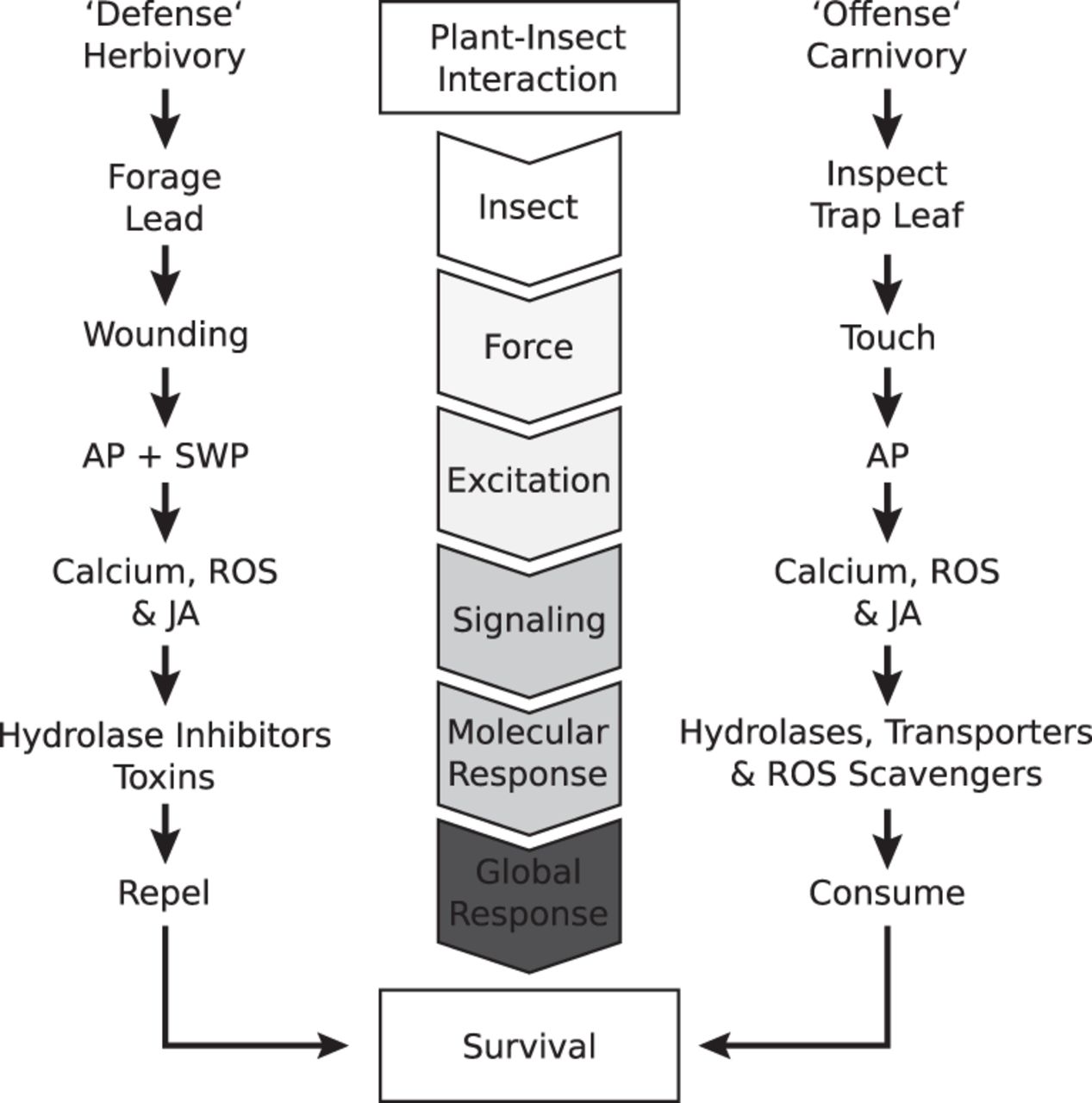
Turning defense into offense. Flow chart comparing the main events occurring at individual levels during the interaction of insects/herbivores with Dionaea or noncarnivorous plants. Similar to noncarnivorous plants, Dionaea attracts insects by means of volatile and nectar production (Kreuzwieser et al. 2014). Herbivores use plant leaves as a food source and by chewing, for example, caterpillars, impose a wounding event on the plant. In Dionaea, visiting insects generate touch events sensed by the trigger hairs of the trap leaf, triggering APs, while in noncarnivorous plants, slow-wave potentials (SWPs) or APs can be generated. APs represent traveling electrical waves that are capable of generating systemic responses in noncarnivores. In Dionaea, however, AP spreading is confined to the stimulated trap; it is not able to cross the trap–petiole anatomical barrier. Both wounding and touch-evoked electrical signaling trigger similar secondary signaling events: changes in cytosolic calcium concentration, production of reactive oxygen species (ROS), and synthesis of the touch hormone JA. Activation of JA signaling in noncarnivorous plants results in the production of a large number of specialized compounds with established roles in defense. This includes alkaloids, terpenoids, phenylpropanoids, phenolamides, amino acid derivatives, anti-nutritional proteins, and some pathogenesis-related (PR) proteins (Mithöfer and Boland 2012). Conversely, activation of the JA signaling pathway in Dionaea further leads to the expression of a broad spectrum of hydrolases (cf. Fig. 3), ROS scavengers, and finally nutrient uptake transporters. Thus, while in noncarnivorous plants the global objective is to repel a herbivore, Dionaea’s only purpose is to consume it. Both strategies are costly, requiring the investment of a substantial amount of metabolic energy; if successful though, they significantly increase the chance of plant survival.



